
Summary
- Wholesale markets, cash & carry outlets and wholesalers that supply small shops are a natural channel for an importer of Tunisian Deglet Nour: they move product in cartons, they reach many independent retailers at once, and their buyers know what they want.
- The formats that usually fit are standard dates loose in cartons, branch dates for display and festive periods, and consumer boxes that a small shop can put straight on the shelf. The Arjoun is an occasional special item, and pitted dates can be discussed on request.
- These buyers expect clear carton sizes, readable outer labels and consistent product from one delivery to the next. Labelling rules depend on your country: check them locally.
- Demand usually peaks before Ramadan (which moves earlier each year), around Eid, at the year-end and when new-crop fruit arrives after the Tunisian harvest.
- Pricing in this channel works in layers: your landed cost, your margin, the wholesaler’s margin and the retailer’s margin. This guide explains the logic without any figure.
- Rotation, storage and reliable repeat orders are what keep a wholesale customer. To prepare an order, request a quote or message us on WhatsApp at +216 52 146 101.
Why wholesale and cash & carry matter for dates
Many importers start by selling to a handful of shops they know personally. That works for a first shipment, but it rarely moves enough volume to justify regular imports. Wholesale channels change the scale. A stall in a wholesale fruit and food market, a cash & carry warehouse where shopkeepers and caterers buy for their business, or a wholesaler with vans delivering to corner shops can each reach dozens or hundreds of small retailers.
These channels have their own habits. Buyers are professionals. They compare quickly, buy by the carton, care about turnover and margin, and come back only if the product sells and the supply is reliable. They are less interested in storytelling than a delicatessen customer, but they notice immediately if a carton is underweight, if the fruit is not the same as last time or if stock runs out at the wrong moment.
This guide is written for importers and distributors who want to place Tunisian Deglet Nour in these channels. It complements, but does not repeat, our other guides:
- selling to delicatessens and specialty stores is covered in Selling Tunisian Deglet Nour in a Specialty Grocery;
- serving shops whose customers already know Tunisian dates is covered in Supplying North African Grocery Stores;
- organising regular shipments over a year is covered in An Annual Supply Programme for Tunisian Dates;
- selling through web shops and marketplaces is covered in Online Sellers Sourcing Tunisian Deglet Nour.
Here the focus is on the wholesale layer itself: what these buyers need, and how an importer can organise the product, the packaging, the prices and the stock to serve them.
Three types of wholesale buyer
The word “wholesale” covers several kinds of business. They overlap, but each has its own way of buying.
Wholesale market traders
In many cities, a central wholesale market brings together traders who sell fruit, vegetables and dry goods to greengrocers, market stallholders, restaurants and small shops. Buyers often come early, compare several stands and buy on the spot. For dates, these traders usually look for loose product in cartons that their own customers can either resell loose or repack, and for branch dates in the weeks before festive periods.
Cash & carry outlets
A cash & carry is a self-service warehouse for professional customers: shopkeepers, caterers, cafés, small restaurants. Products sit on shelves or pallets, with prices displayed per unit and per case. Buyers pay and take the goods away themselves. Cash & carry buyers usually want products that are ready to sell: consumer boxes in an outer case, clear barcodes where required, and a product that looks the same every time.
Wholesalers supplying small shops
Some wholesalers take orders from independent grocers, convenience stores and kiosks, then deliver on a round. Their range is broad, and dates are one line among many. They value easy handling (standard carton sizes that fit their vans and shelves), reliable availability and predictable seasonal stock.
The table below summarises how these buyers usually differ.
| Buyer type | What they usually buy | What matters most to them | Points to discuss with your supplier |
|---|---|---|---|
| Wholesale market trader | Standard dates loose in cartons, branch dates before festive periods | Price per carton, visual quality, speed of turnover | Carton net weight, consistency between lots, seasonal timing |
| Cash & carry outlet | Consumer boxes in outer cases, sometimes loose cartons | Shelf-ready packaging, labels, steady supply | Retail pack sizes, outer case format, labelling responsibilities |
| Wholesaler supplying small shops | Consumer boxes and smaller cartons | Easy handling, availability, reliable deliveries | Carton dimensions, palletisation, order rhythm |
| Any of the above, occasionally | Arjoun for a festive display or a special order | Visual impact, a story for their customers | Quoted case by case, lead time agreed early |
Which product forms fit the wholesale channel
Standard dates loose in cartons
Standard dates are the everyday Deglet Nour: whole dates, sold loose. In wholesale channels they are usually the core volume product. A greengrocer or a market stallholder can sell them loose by weight; a small shop or a caterer can repack or use them directly. What wholesale buyers look for here is simple: a carton that holds the declared net weight, fruit that matches the previous delivery, and a clear label on the outside.
Branch dates
Branch dates, still attached to their strands, are a display product. They catch the eye on a market stall or at the end of a cash & carry aisle, and they sell well before festive periods when customers want something to put on the table or to give. Branch dates are more delicate to handle than loose dates, so carton size, protection and stacking deserve attention.
Consumer boxes
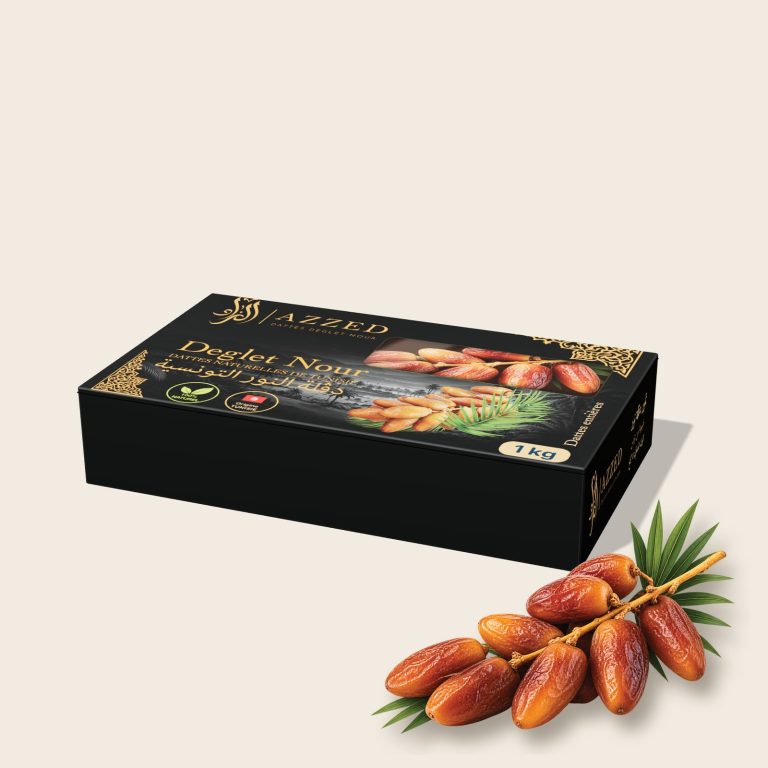
Small shops and many cash & carry customers prefer products they can put on the shelf without repacking. Consumer boxes of Deglet Nour, packed in outer cases, fit this need. Whether the boxes are packed at origin or repacked in your country is a decision with consequences for cost, labelling and lead time. Our guide on retail packaging and labelling explains the general points; specific packaging is something to discuss case by case in the quote.
The Arjoun and pitted dates
The Arjoun, the whole bunch as it comes from the palm, is not a volume product for wholesale. It can be an occasional special item for a trader who wants a striking display before a festive period, or for a customer who places a special order. Pitted dates can be discussed on request for buyers such as caterers who prefer them. Both are quoted case by case.
For a first shipment, combining these forms in one order is often the most practical way to see what each wholesale customer prefers. Our guide on a mixed first order explains how to compose one, and the grades guide describes the differences between forms.
Carton sizes and labelling expectations
Wholesale buyers handle large numbers of cartons. Anything that makes handling easier helps the product sell; anything that creates doubt slows it down.
Carton sizes
There is no single standard carton for dates, and practices vary between markets. When you plan the range, ask your wholesale customers what they prefer, then discuss it with your supplier. Points to clarify:
- Net weight per carton and how it is checked.
- Carton dimensions and strength, so that cartons stack safely on pallets and in vans.
- Number of cartons per pallet, if goods are palletised, and how pallets are wrapped.
- For consumer boxes, the number of boxes per outer case, which should suit the way the cash & carry or wholesaler sells (by the case or by the unit).
Fewer carton formats are usually easier to manage than many. A short, clear range lets your customers reorder without hesitation.
Labels on outer cartons
The outer label is what a warehouse worker or a market trader reads first. In general terms, it usually shows the product name and variety, the origin, the net weight, a lot code and a best-before or packing date, plus the information your importer status requires in your country. Whether a barcode is needed depends on your customers: cash & carry outlets often expect one, wholesale market traders less often.
Labels on consumer packs
Consumer packs must follow the labelling rules of the destination market: product name, net quantity, origin, importer details, storage advice, date marking and the required languages, among other items. These rules vary by country and change over time. Check them locally, with your customs broker, a food-labelling adviser or the relevant authority, before artwork is printed. Who prepares and approves the artwork is a point to settle in the quote.
Seasonal peaks and how to prepare for them
Dates sell all year, but wholesale demand is far from even. Wholesale buyers stock up before their own customers do, which means your peak comes earlier than the retail peak.
New-crop arrival
The Deglet Nour harvest in southern Tunisia generally runs from autumn into early winter. The first new-crop shipments are a natural moment to visit wholesale customers, show the fresh fruit and take orders. Our harvest calendar for importers explains the timing.
Ramadan and Eid
For many wholesale customers, the weeks before Ramadan are the most important of the year for dates. Ramadan follows the lunar calendar and starts roughly ten to eleven days earlier each year in the Gregorian calendar; in 2027 it is expected to begin around mid-February. Wholesale buyers often want their stock several weeks before the month starts, so the import itself has to be planned well before that. Our guide on planning Ramadan 2027 date stock helps you work backwards from the start date. Eid at the end of the month is a second, shorter peak.
Year-end
In many markets, the end of the year brings festive tables, hosting and gifts. Branch dates and consumer boxes move well in this period, especially through cash & carry outlets that supply caterers and small shops. For gift-oriented ranges, see Tunisian date gift boxes for seasonal gifting.
Planning around the peaks
A practical approach is to ask your main wholesale customers, well in advance, what they expect to need for each peak, then build your import plan from their answers and your own records. Transport, customs clearance and the supplier’s own lead time all take time; a forecast that arrives too late is a forecast that cannot be served.
Pricing logic in a layered channel
Wholesale channels add layers between you and the end customer. Understanding these layers helps you set a price that works for everyone, without any figure being universal.
The layers
A Deglet Nour carton sold through wholesale usually passes through several hands, and each adds its own margin:
- Your landed cost: the supplier price plus everything between the supplier and your warehouse. Our guide on building the landed cost explains how to calculate it.
- Your margin as importer or distributor, which has to cover your own overheads, storage, financing, losses and sales effort.
- The wholesaler’s or cash & carry’s margin, which covers their space, staff, handling and risk.
- The retailer’s margin, which covers the shop’s own costs and the time the product sits on the shelf.
The end price on the shelf has to stay within what customers in that market are willing to pay. If it does not, one of the layers is squeezed, usually yours.
What influences your room for manoeuvre
- Product form and packaging. Loose cartons usually carry fewer packaging costs than consumer boxes, but the retailer then has to repack or sell by weight. Consumer boxes cost more to produce but save work further down the chain.
- Volume and regularity. Larger, regular orders spread fixed costs and let you negotiate better terms with forwarders and service providers. Our article on what moves an export quote explains the supplier side of the equation.
- Season. Prices and demand both move around the peaks. Stock bought late, or stock left after a peak, changes your margin.
- Losses. Damaged cartons, samples, returns and product sold at a reduced price near the end of its life all reduce what you actually earn.
Practical principles
- Know your landed cost per sellable unit before you quote any wholesale customer.
- Quote per carton and per unit where your customers expect it, so that comparison is easy.
- Agree price review rules with your regular customers, for example at the start of each season, rather than changing prices without notice.
- Do not chase the lowest price at the expense of consistency. Wholesale customers who are let down by a product rarely come back.
Rotation and storage
Dates are a natural product. How they are stored and how quickly they move have a direct effect on how they look when they reach the end customer.
In your warehouse
Keep stock in a cool, dry place, away from heat sources and direct sun, in closed cartons, with first-in, first-out rotation. Stable conditions matter: temperature swings can make dates sticky or encourage sugaring. Our guide on storing Deglet Nour dates in an importer’s warehouse gives more detail, and the article on sugaring explains this natural phenomenon and how to talk about it with customers.
At your wholesale customers
You do not control your customers’ storage, but you can help. A short sheet with simple storage advice, given with the first delivery, makes it easier for a market trader or a cash & carry manager to keep the product in good condition. Encourage them to:
- keep cartons closed until they are needed;
- avoid placing dates near ovens, heaters, windows or cold-air vents;
- sell older lots first, using the lot code or date on the carton;
- order in quantities they can sell in a reasonable time rather than overstocking before a peak.
Watching the age of stock
Keep a simple record of which lots went to which customer and when. If a customer reports a problem, you can trace it quickly. If a lot is moving slowly, you can act before it becomes a loss, for example by offering it first to customers with faster turnover.
Building repeat orders
In wholesale, the first sale is only the beginning. The real business comes from customers who reorder season after season.
What keeps a wholesale customer
- Consistency. The same product, the same carton, the same label, delivery after delivery. A written product specification sheet agreed with your supplier helps keep it that way.
- Availability. Being in stock when your customer needs it, especially before the peaks.
- Clear communication. Telling customers early when a new crop is arriving, when a format changes or when a delay is possible.
- Simple ordering. A short product list, clear prices per carton, and a predictable delivery rhythm.
Organising your side
- Record what each customer buys, by product form and by month. After one year, you have a forecast.
- Review after each season: which formats sold, which cartons were awkward, where stock ran short or stayed too long.
- Share your forecast with your supplier as early as possible. When repeat orders become regular, an annual supply programme can help you split your needs into scheduled shipments.
- Inspect every arrival before stock goes out to customers, as described in arrival inspection and quality claims, so that any problem is caught in your warehouse rather than at your customer’s.
Common mistakes in the wholesale channel
- Offering too many formats at once, which confuses buyers and splits stock.
- Under-planning the Ramadan peak because the date moves earlier each year.
- Quoting without a full landed cost, then discovering that the margin has disappeared.
- Changing carton size or label without warning, which disrupts customers’ handling and shelf labels.
- Ignoring storage at the customer’s end, then receiving complaints about sticky or sugared fruit.
- Treating every wholesale buyer the same way, when a market trader, a cash & carry and a delivery wholesaler have different needs.
Frequently Asked Questions
Which Deglet Nour format sells best through wholesale markets?
In general, standard dates loose in cartons are the core volume product, with branch dates adding visual appeal before festive periods. The right mix depends on your customers; a mixed first order helps you find out.
Do cash & carry outlets need consumer boxes?
Many cash & carry customers prefer shelf-ready products, so consumer boxes in outer cases are often useful. Some also sell loose cartons to caterers and greengrocers. Ask the outlets you plan to supply.
What should appear on the outer carton label?
In general terms: product name and variety, origin, net weight, a lot code and a date, plus the information your country requires from the importer. Check the exact rules locally with your broker or a labelling adviser.
When should I import for the Ramadan peak?
Early enough for your wholesale customers to have stock several weeks before the month starts, which means planning the import well before that. Ramadan 2027 is expected to begin around mid-February. See our Ramadan planning guide.
How do I set a wholesale price without squeezing my margin?
Start from your landed cost per sellable unit, add your own margin, then check that the wholesaler’s and retailer’s margins still lead to a shelf price your market accepts. Our landed cost guide explains the first step.
Can I sell the Arjoun through a cash & carry?
It is not a volume product, but it can be an occasional special item for a festive display or a special order. The Arjoun is quoted case by case.
Can Azzed pack consumer boxes for my market?
Packaging, carton formats and labelling are discussed case by case in the quote, together with prices, Incoterm, documents and payment terms. Tell us what your wholesale customers expect when you request a quote.
Where do your dates come from?
Our Deglet Nour comes from the oases of Douz and Kébili, in the Nefzaoua region of southern Tunisia. See our Deglet Nour dates and Quality pages.
Conclusion
Wholesale markets, cash & carry outlets and wholesalers that supply small shops can turn an occasional import of Tunisian Deglet Nour into a regular business. The method is practical: understand each type of wholesale buyer, offer a short range of formats (standard dates in cartons, branch dates, consumer boxes, the Arjoun as an occasional extra), make cartons and labels easy to handle, plan imports well ahead of Ramadan, Eid and the year-end, price from a full landed cost with every margin layer in mind, rotate and store with care, and build repeat orders on consistency and reliable supply.
These buyers are demanding, but they are also loyal when a product sells well and arrives as promised. A clear range and a well-prepared supply plan are the best arguments you can bring to them.
Azzed is a local Tunisian Deglet Nour brand from the oases of Douz and Kébili. We are still building our export activity, and we study every request from small and mid-sized buyers for all our products: standard dates, branch dates, the Arjoun and pitted dates on request. To prepare an order for your wholesale customers, request a quote, read our Export page, browse our Products, or message us on WhatsApp at +216 52 146 101.
Read next: An Annual Supply Programme for Tunisian Dates