
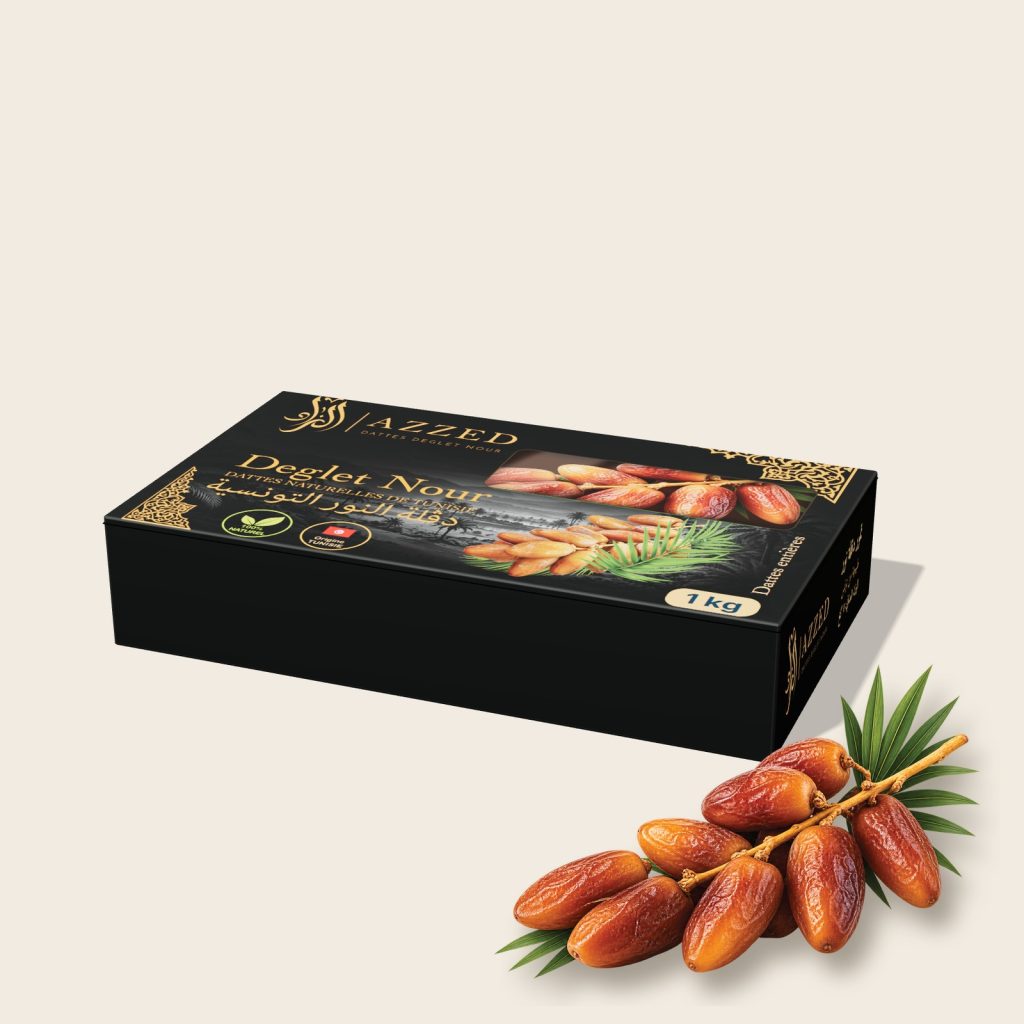
Summary
- Selling dates online is not the same as selling them in a shop. Your customer cannot touch or taste the fruit before buying, and every order travels alone, in a parcel, through a network you do not control. Both facts shape what you should source.
- Branch dates photograph beautifully and work well as a hero product or a gift item. Standard dates are the practical base for everyday packs, refills and subscription boxes. The Arjoun is an occasional special item, and pitted dates on request can suit snack-style ranges.
- Parcel shipping adds three risks to manage: crushing, moisture and heat. Packaging, dispatch timing and seasonal planning matter as much as the fruit itself.
- Your listings are your shop window. Use consistent photos and honest descriptions: variety, origin (the oases of Douz and Kébili in southern Tunisia), harvest season, storage advice. Avoid claims you cannot prove.
- Start with a small first order by quote, test your packaging and your listing, then settle into a re-ordering rhythm that keeps your stock fresh.
- Azzed is a local Tunisian brand of Deglet Nour. We are not a large exporter, but we study every request, including small ones from online sellers. Request a quote or message us on WhatsApp at +216 52 146 101.
Who this guide is for
This article is written for businesses outside Tunisia that sell food online and want to add Tunisian Deglet Nour to their range:
- independent e-commerce brands with their own web shop, selling dried fruit, healthy snacks, gourmet food or Mediterranean and North African products;
- marketplace sellers listing food products on large online platforms;
- subscription box companies that send curated food boxes every month or every season;
- gift box and hamper businesses that sell mainly online, especially around Ramadan, Eid and the year-end holidays;
- social commerce sellers who sell through their own social media pages and messaging apps, often to a community that already knows dates well.
If you run a physical shop, our guide on selling Tunisian Deglet Nour in a specialty grocery is a better fit. If you supply North African and Middle Eastern grocery stores, see supplying North African grocery stores with Tunisian dates.
Tunisia is one of the world’s major date producers, and Deglet Nour is its best-known variety. For an online seller, that is good news: the fruit is familiar to many customers, easy to explain to others, and available every season. The challenge is not finding dates. It is turning a natural, seasonal fruit into a product that looks the same on screen as it does when the parcel is opened.
Why online selling changes the sourcing decision
A shop customer sees the fruit, picks the box they like and carries it home. An online customer makes a decision from a photo and a few lines of text, then waits for a parcel. That changes your priorities as a buyer.
The photo becomes a promise
Whatever you show in your listing, the customer expects to receive. If your photo shows glossy, amber, perfectly shaped dates on the strand and the parcel contains loose, slightly dry fruit, you will get complaints and poor reviews, even if the fruit itself is good. Your sourcing must therefore match your photos, not the other way round.
Every order is a small, fragile shipment
In a shop, dates arrive in cartons on a pallet and stay on a shelf. Online, each order is handled several times, sorted by machines, stacked under heavier parcels and sometimes left in a hot van or a cold doorway. Fruit that travels well in bulk can suffer in single parcels if the inner packaging is weak.
Reviews and returns are public
A shop owner can talk to an unhappy customer at the counter. Online, a disappointed customer writes a review that every future buyer can read. Consistency between lots, careful packing and honest descriptions protect your rating more than any promotion.
Repeat orders are the business model
Most online food sellers rely on customers who come back: subscribers, regular buyers, people who reorder every Ramadan. That means the second, third and tenth parcel must look and taste like the first. Your supplier relationship needs to be built for regularity, not for a single opportunistic purchase.
Choosing the right form for an online range
Azzed sells Deglet Nour in a few presentations. Each one has a different role in an online catalogue.
Branch dates: the product that sells from a photo
Branch dates are Deglet Nour still attached to their fine strands. On screen, they immediately say “fresh from the palm” and “authentic”. They work well as:
- a hero product at the top of your category page;
- a gift item for Ramadan, Eid or the year-end season;
- the visual anchor of a gift box or hamper;
- the main image of your brand’s social media posts.
The trade-off is that branch dates take more space, need gentler packing and are more delicate in a parcel. They are best sold in rigid boxes and shipped with care.
Standard dates: the everyday base of the range
Standard dates are loose Deglet Nour, detached from the strand. For online selling, they are usually the backbone of the catalogue:
- they pack efficiently in pouches, tubs or boxes;
- they travel more easily in a parcel;
- they suit everyday packs, refills, family sizes and subscription boxes;
- they are easier to portion if you repack them yourself, in line with your local food rules.
Many online sellers use branch dates to attract attention and standard dates to build repeat orders.
Arjoun: an occasional special item
The Deglet Nour Arjoun is the whole bunch of dates, as harvested. It is spectacular for events, wedding tables or a limited seasonal offer, but it is large, heavy and not designed for routine parcel shipping. If you want to offer it online, treat it as a special order item with its own delivery arrangement, quoted case by case.
Pitted dates, on request
For snack-style ranges, office boxes or “ready to eat” positioning, pitted dates on request can make sense. Keep in mind that pitted fruit is opened fruit: it is generally more sensitive to handling and drying out, so plan shorter storage and good packaging. Pitted dates are discussed case by case in the quote.
Quick reference table
| Online use | Form that usually fits | What to check before listing |
|---|---|---|
| Hero product, gift item, seasonal campaign | Branch dates | Rigid packaging, careful packing, photo matches the real product |
| Everyday pack, refill, family size | Standard dates | Pack format, seal quality, storage advice on the label |
| Subscription box or tasting box | Standard dates, or a few branch dates as a highlight | Portion size, consistency between monthly lots |
| Snack range or office box | Pitted dates on request | Shorter shelf life once opened, tolerance agreed in the quote |
| Event or limited special offer | Arjoun, by quote | Delivery arrangement, lead time, clear listing description |
For a broader view of the grades, see Deglet Nour Grades Explained. If you want to test several forms at once, our article on building a mixed first order explains how to combine them.
Packing dates for parcel shipping
Your supplier ships cartons to you or to your warehouse. From there, you, your fulfilment partner or your marketplace ship individual parcels to customers. That second journey is where most problems appear. Three risks deserve attention.
Protection against crushing
Dates are soft fruit. A thin pouch in a padded envelope can arrive flattened, with burst fruit and sticky surfaces.
- Prefer rigid or semi-rigid inner packaging, such as boxes, tubs or trays, for branch dates and premium packs.
- For pouches, use a sturdy outer box rather than a soft envelope, and fill empty space so the pack cannot move.
- Test a few parcels yourself: send them to a colleague or a friend, through your normal carrier, and look at what arrives.
Protection against moisture
Moisture is the quiet enemy of dates. Condensation inside a sealed pack, or humidity during transit, can make fruit sticky, encourage surface sugar crystals or, in bad conditions, affect quality more seriously.
- Use well-sealed food packaging that keeps outside humidity away.
- Avoid packing dates straight from a cold store into a warm room: let cartons reach room temperature before opening them, so condensation does not form on the fruit.
- Keep dates away from wet goods in the same parcel.
Protection against heat
Heat softens dates, makes them sticky and can damage their appearance. Parcel networks are not climate-controlled.
- In hot periods, consider dispatching early in the week, so parcels do not sit in depots over a weekend.
- Avoid long delivery options in the hottest months if you can.
- Tell customers in your listing to store the dates in a cool, dry place on arrival.
Packaging for retail, including what usually appears on a label, is covered in our guide to retail packaging and labelling of Tunisian dates. Whether you sell the packs as they come from the supplier or repack them yourself, check the rules that apply to food sold online in your country.
Shelf life and storage in general terms
Dates are naturally a long-keeping fruit, but “long-keeping” does not mean “unchanged”. For an online seller, storage affects both product quality and the accuracy of your listings.
What changes over time
Deglet Nour from the new crop is usually at its softest and most translucent early in the season. Over the following months, even in good storage, fruit tends to become firmer and drier, and its colour can deepen. That is normal, but it means a photo taken at the start of the season may not match the fruit you ship much later.
Where to keep your stock
Whether you store dates yourself or with a fulfilment centre:
- keep cartons in a cool, dry place, away from heat sources and direct sunlight;
- keep them away from strong odours, as dates can absorb smells;
- raise cartons off the floor and leave space for air to circulate;
- apply first in, first out, and write the reception date on each carton;
- inspect regularly for stickiness, sugar crystals, unusual smells or any sign of pests.
If you use a third-party fulfilment centre, ask how food products are stored there, and whether storage areas can become hot in summer. Our article on storing Deglet Nour in an importer’s warehouse goes into more detail on storage conditions and rotation.
Best-before dates
The best-before date on your packs must be realistic and consistent with your storage conditions and your local rules. Agree with your supplier on how lots are identified, so you can track which lot went into which packs. When in doubt, ask your food safety adviser.
Consistent photos and honest descriptions
For an online seller, the listing is the product until the parcel arrives. Here is how to make it accurate and trustworthy.
Photograph the real product
- Use your own photos of the fruit you actually receive, not generic images found online.
- Shoot in natural light, against a simple background, so the colour of the fruit is realistic.
- Show the product as the customer will receive it: inside the pack, then opened, then a close-up of a few dates.
- Keep the same style, light and background across your range, so customers recognise your brand.
- Retake photos when the product changes noticeably, for example later in the season or after a packaging change.
Write what you can stand behind
A good description is specific and honest. You can usually state:
- the variety: Deglet Nour;
- the origin: Tunisia, from the oases of Douz and Kébili in the Nefzaoua region, if that is what your supplier confirms;
- the presentation: branch dates, standard loose dates, pitted dates;
- the harvest season: the Deglet Nour harvest generally runs from October to December, so you can mention the crop year when your supplier confirms it;
- the taste and texture: delicate, honey-like sweetness, tender but firm flesh, amber colour;
- storage advice: cool and dry, closed pack after opening;
- the net weight, as printed on the pack.
What to avoid
- Health or nutrition claims you have not checked against the rules of your market.
- Production claims your supplier has not confirmed in writing. Do not add labels or quality schemes to your listing because they sound attractive.
- Superlatives such as “the best dates in the world”. They add little and can create problems on some platforms.
- Mixing up varieties. Deglet Nour is not Medjool. If customers ask, our comparison Deglet Nour vs Medjool explains the difference simply.
Honest descriptions reduce returns and complaints, and they protect your account on platforms that check food listings.
Starting with a small first order by quote
Online sellers often start small, and that is the right approach. A first order is a test of the fruit, the packaging, the parcel journey and the listing, all at once.
Before you order: samples
Ask for samples before committing to a first lot. Taste them, photograph them, pack a few test parcels and send them through your carrier. Our guide on evaluating Deglet Nour samples before a first order gives a full method.
Writing your request
Our article How to Write a Request for Quotation for Tunisian Dates covers the general structure. As an online seller, add these points:
- Your sales channels: own web shop, marketplace, subscription box, social commerce.
- The forms you want to test: branch dates, standard dates, pitted on request, Arjoun for special orders.
- How you will sell them: as supplied, or repacked by you or your packer.
- Your first quantity, described honestly as a trial, and your expected rhythm if the test works.
- Your peak periods: Ramadan, Eid, year-end, other seasonal campaigns.
- Packaging expectations: carton size, inner packaging, lot identification.
- Destination and Incoterm, or “please suggest”.
- Sample address, where you can test parcel shipping.
To understand why quotes vary between suppliers and seasons, read what makes an export quote go up or down. Payment conditions are agreed in the quote; our article on payment terms for a first export order explains the usual options. Transport, Incoterms and documents are covered in our shipping guide for first-time importers.
What to measure during the test
Once your first lot is online, watch more than sales:
- condition on arrival, from customer messages and test parcels;
- review comments about taste, texture and packaging;
- which form sells better: branch dates or standard dates;
- how fast stock moves, which tells you how often you need to reorder;
- storage behaviour in your own warehouse or fulfilment centre.
Planning a re-ordering rhythm
Once the test is conclusive, the question becomes how often to reorder. For online sellers, smaller and more regular orders often work better than one large annual purchase.
Why regular orders help
- Each delivery is closer to the harvest, so your fruit stays fresher and your photos stay accurate.
- You tie up less cash in stock that sits in storage.
- You can adjust your range between orders based on what customers actually buy.
- Your supplier can plan ahead when they know your rhythm.
Working with the season
The harvest calendar shapes availability and freshness. New-crop fruit is usually available towards the end of the year, while demand for dates peaks before Ramadan and during the year-end holidays. Our harvest calendar for importers explains the season month by month, and our Ramadan planning guide helps you work backwards from your campaign dates.
A simple planning habit
Many online sellers keep a short planning sheet:
- expected campaigns for the coming months;
- current stock and its reception dates;
- the lead time agreed with the supplier, plus transport time;
- the latest date to send a new request so stock arrives before each peak.
Share your rough plan with your supplier early. It costs nothing and makes every later order smoother.
Common mistakes when sourcing dates for online sales
Using photos that do not match the product
Beautiful stock images of a different presentation or variety lead straight to disappointed customers. Photograph what you sell.
Testing the fruit but not the parcel
Fruit that is perfect on arrival at your warehouse can arrive crushed or sticky at the customer’s door. Always test the full parcel journey.
Ordering too much for a first test
A large first order ties up money and storage, and if the format or the listing needs adjusting, you are stuck with stock. Start small.
Forgetting the peak season lead time
Ordering in the last weeks before Ramadan or the year-end leaves no margin for samples, transport or delays. Plan early.
Over-promising in listings
Claims you cannot support, or a vague origin, create risk on marketplaces and with customers. Keep the description factual.
How Azzed works with online sellers
Azzed is a local Tunisian brand of Deglet Nour from the oases of Douz and Kébili, in the Nefzaoua region. We are honest about our position: we are not yet well established in export, and we do not claim volumes, destinations or customer references.
- We study every request, including a first trial order from a small online brand.
- We quote for our whole range: branch dates, standard dates, Arjoun and pitted dates on request. See our Products page and our Deglet Nour page.
- We tell you what is realistic on packaging, timing and documents before the order.
- We discuss private label and pack formats case by case, in the quote.
You can read more about how we select and pack the fruit on our Quality page, and about our approach to foreign buyers on our Export page.
Frequently Asked Questions
Which Deglet Nour form is best for an online shop?
Most online sellers combine two: branch dates as a visual, gift-oriented product, and standard dates for everyday packs, refills and subscriptions. Pitted dates on request can suit snack ranges, and the Arjoun works as an occasional special order.
Can I sell Azzed dates under my own brand?
Private label and pack formats are discussed case by case in the quote. Explain your project, your channels and your expected rhythm, and we will tell you what is realistic.
How should I pack dates for parcel delivery?
Use well-sealed food packaging, preferably rigid or semi-rigid for premium packs, inside a sturdy outer box with no empty space. Avoid hot dispatch periods and test a few parcels through your carrier before launching.
How long do Deglet Nour dates keep?
Dates are a long-keeping fruit when stored cool and dry, but they become firmer and drier over the months. Set realistic best-before dates in line with your storage conditions and local rules, and apply first in, first out.
What can I write in my product description?
State the variety, the origin, the presentation, the harvest season when confirmed, the taste and texture, storage advice and the net weight. Avoid health claims, unproven production claims and superlatives.
Can a small online brand order from Azzed?
Yes. We study small and mid-sized requests. Describe your channels, your first trial quantity and your expected rhythm, and we will reply with a proposal.
Should I order samples first?
Yes. Samples let you taste the fruit, take your first photos and test the parcel journey before committing to a first lot.
How do I request a quote?
Use our contact form or message us on WhatsApp at +216 52 146 101, with your channels, the forms you want, your first quantity, destination and sample address.
Conclusion
Selling Tunisian Deglet Nour online works when the product the customer receives matches the product they saw on screen. That depends on a few concrete choices: branch dates for visual appeal, standard dates for everyday packs and repeat orders, packaging built for parcels, careful storage, consistent photos and honest descriptions. Start with samples and a small first order, measure how the fruit travels and sells, then settle into a regular re-ordering rhythm that keeps your stock fresh.
If you want to add Deglet Nour from the oases of Douz and Kébili to your online range, we would be glad to study your project. Request a quote, browse our Products, or message us on WhatsApp at +216 52 146 101.
Read next: Retail Packaging and Labelling for Tunisian Dates
More buyer guides
 Supplying North African and Middle Eastern Grocery Stores with Tunisian Deglet Nour: A Guide for Importers and WholesalersTunisian Deglet Nour as an Ingredient: A Buyer’s Guide for Bakeries and Small Food Manufacturers
 From Bulk Carton to Shelf: Planning Retail Packs and Labels for Tunisian Deglet Nour