
Summary
- A mixed first order combines several presentations of the same fruit in one shipment. For a small or mid-sized buyer, it is often the most practical way to learn what your customers actually buy before committing to a single product.
- With Deglet Nour, the main building blocks are standard dates, branch dates, Deglet Nour Arjoun (the whole bunch) and pitted dates on request. Each one answers a different customer and a different sales channel.
- A good mix starts from your channels and your storage, not from the supplier’s catalogue. Decide which question each product line is supposed to answer.
- The proportions in this article are illustrative examples only. They are not recommendations for every market, and they say nothing about minimum quantities or prices.
- Your request for quotation should describe the mix line by line: presentation, packaging, labelling, quantity range and purpose of each line.
- At Azzed, we study every request, including small mixed trial orders. Tell us about your project or message us on WhatsApp at +216 52 146 101.
Why a mixed first order makes sense for smaller buyers
Large importers can afford to test a market slowly, with dedicated budgets, several suppliers and many shipments. A small importer, a delicatessen group or a regional wholesaler usually cannot. The first order has to do two jobs at once: supply real customers and generate the information you need for the second order.
Ordering a single product answers only one question: “Does this product sell?” If the answer is “not very well”, you do not know whether the problem was the fruit, the presentation, the price point or the channel. A mixed order lets you compare, in the same season and with the same customers, how different presentations perform.
For Tunisian Deglet Nour, this is particularly useful because the same variety reaches the shelf in very different forms. The loose fruit in a retail box, a strand of dates still attached to the branch, a whole bunch and a pitted date are four distinct experiences for the end customer. They sit in different places in a store, they appeal to different buyers and they carry different handling constraints.
There is a second advantage: a mixed order shows you how a supplier works across its range. You see whether packaging is consistent, whether labelling is handled carefully on every line and whether the documents cover the whole shipment correctly. That is valuable information before any larger commitment.
The building blocks: what each presentation is for
Before deciding on proportions, be clear about the role of each product. Our article Deglet Nour Grades Explained describes the presentations in detail; here we look at them from a market-testing point of view.
Standard dates: the everyday line
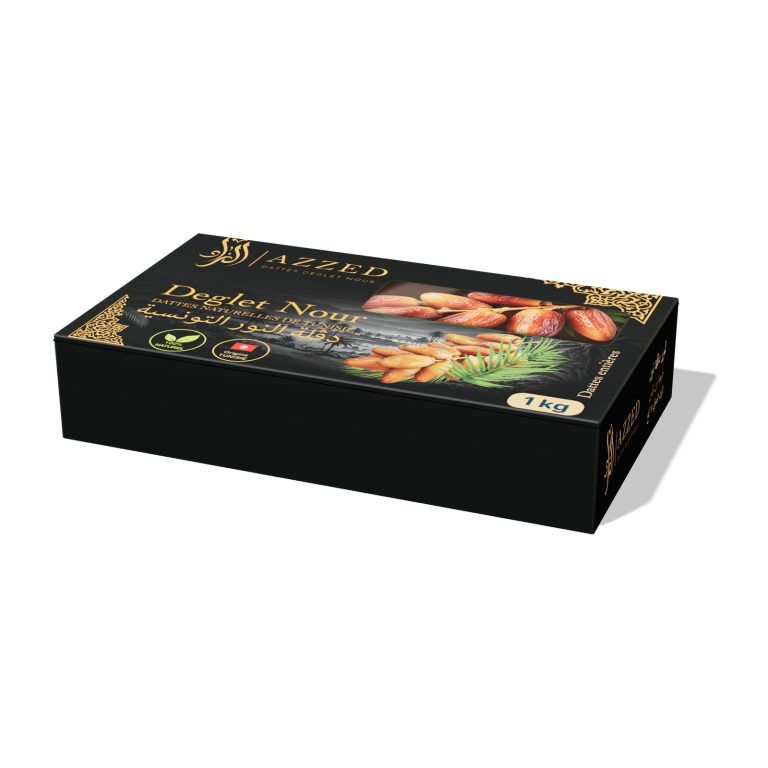
Standard dates are loose Deglet Nour, removed from the strand and packed in boxes or cartons. They are the presentation most customers recognise as “dates” and the one that usually fits everyday retail, food service and repacking.
In a mixed order, standard dates are often the reference line: the product against which you measure the others. If they sell steadily, you know there is base demand for Tunisian Deglet Nour in your channel.
Branch dates: the presentation line
Branch dates keep the fruit attached to the strand. Visually, they tell the story of the oasis, which is why many retailers use them for display, seasonal gifting and premium shelves.
In a test, branch dates answer a different question: does your customer pay attention to presentation and origin? They are also more delicate to handle, so they tell you something about your own logistics and display conditions.
Deglet Nour Arjoun: the showpiece
Deglet Nour Arjoun is the whole bunch as it comes from the palm. A bunch can weigh up to about 20 kg, and it is supplied on quotation. It is not an everyday retail item. It works for events, store displays, hospitality, trade fairs and customers who want something visibly authentic.
In a mixed order, a small number of Arjoun bunches can act as a visibility tool rather than a volume line. Before including them, check that you have the space, the handling and the right channel to use them.
Pitted dates on request: the convenience and ingredient line
Pitted Deglet Nour is available on request, so it must be discussed explicitly in your quotation. Pitted dates are a different product: they suit snacking, food service, bakeries and kitchens where convenience matters.
In a test, a pitted line answers the question: is there demand from professional or convenience-driven buyers? Because it is prepared on request, it needs a clear specification and should be mentioned at the very start of the discussion.
Summary table
| Presentation | Typical role in a test | Likely channels | Points to check before including it |
|---|---|---|---|
| Standard dates | Reference line, base demand | Grocery, retail, food service, repacking | Box or carton format, labelling language |
| Branch dates | Presentation and origin story | Delicatessen, gift shelves, seasonal displays | Handling, display conditions, carton protection |
| Deglet Nour Arjoun | Visibility, events, showpiece | Hospitality, events, fairs, flagship stores | Space, weight per bunch, customer use |
| Pitted (on request) | Convenience and professional use | Bakeries, caterers, snacking, kitchens | Specification, packaging, lead time |
Start from your channels, not from the catalogue
The most common mistake in a mixed order is to take “a bit of everything” without a reason. Every line should answer a question you actually want answered. A simple method:
- List your sales channels. For example: two independent grocery stores, one online shop, one restaurant client, a seasonal market stall.
- Write down what each channel already sells. If your grocery customers already buy loose dates from another origin, standard Deglet Nour is a direct comparison. If your online shop sells gift items, branch dates may fit better.
- Formulate the question for each line. “Will our grocery customers switch to Tunisian Deglet Nour?” “Will gift buyers choose branch dates over boxed fruit?” “Will our restaurant client use pitted dates in desserts?”
- Drop the lines that have no question attached. If you have no event or hospitality channel, an Arjoun bunch may just occupy space.
- Check your storage. Dates need cool, dry conditions. If you have limited space, prioritise the lines with the clearest question.
This exercise usually takes an afternoon, and it turns a vague “trial order” into a structured test that you can evaluate afterwards.
Illustrative ways to split a mixed first order
The examples below show how different buyers might think about the balance between lines. They are examples only: the percentages are not recommendations, they do not reflect any real customer of ours and they say nothing about minimum order quantities, availability or price. Your own split depends on your market, your channels and the quotation you receive.
| Example buyer profile (illustrative) | Standard dates | Branch dates | Arjoun | Pitted on request |
|---|---|---|---|---|
| Neighbourhood grocery importer, everyday focus | Large majority, for example around 70% | Around 20% | None or one bunch for display | Around 10%, if a professional client exists |
| Delicatessen or gift-oriented retailer | Around 40% | Around 50% | One or two bunches for the store | Optional |
| Regional wholesaler testing several customer types | Around 50% | Around 25% | Small share for event clients | Around 25% |
| Food service or catering supplier | Around 30% | Small share for presentation | Optional, for buffets or events | Majority, for example around 60% |
Read these as starting points for your own thinking. A delicatessen with a strong Ramadan season might put more weight on branch dates in winter, while a wholesaler serving bakeries might drop branch dates altogether. The value of the exercise is not the exact percentage; it is making the logic of the order explicit.
Keep the test readable
Two practical rules help:
- Limit the number of variables. If you change the presentation, the packaging size and the labelling language at the same time, you will not know which factor made the difference. In a first order, keep packaging and labelling as consistent as possible across lines.
- Give each line enough presence on the shelf. A line that is too small to be seen will not sell, and you may conclude wrongly that customers do not want it. Discuss realistic quantities per line with the supplier.
Packaging and labelling across the mix
A mixed order multiplies packaging decisions. Clarify them early.
- Unit format per line. Standard dates might come in consumer boxes or in bulk cartons for loose display and repacking; ask which formats can be supplied for an export order. Branch dates need packaging that protects the strands. Arjoun bunches have their own handling needs. Pitted dates usually travel in packaging adapted to professional use.
- Outer cartons and pallet composition. In a mixed shipment, ask how the different lines will be arranged on pallets and how cartons will be identified. Clear carton marking saves time at reception.
- Labelling. In most markets, the business placing the product on the market is responsible for label compliance. Check the requirements with your authority or customs broker, then send the exact mentions and languages to the supplier for each line.
- Your own sticker. Many small importers apply their own importer sticker after arrival. Say so in the quotation request, so the supplier leaves room on the pack.
If you plan to sell under your own brand later, mention it now, even if the first order is under the supplier’s brand. It helps the supplier anticipate.
What to ask in your quote request for a mixed order
A mixed order needs a slightly more structured request than a single-product order. Our guide How to Write a Request for Quotation for Tunisian Dates covers the general checklist. For a mixed order, add a line-by-line table and a few specific questions.
A line-by-line description
For each line, state:
- presentation (standard, branch, Arjoun, pitted on request);
- whole or pitted;
- unit packaging and outer carton;
- labelling language and mandatory mentions;
- an approximate quantity range, honestly stated;
- the purpose of the line (“test for gift season”, “reference line for grocery stores”).
Questions specific to a mixed order
- Can all lines be shipped together? Ask whether the presentations can be packed and shipped in the same consignment, and whether some lines need a different schedule.
- Is there a minimum per line? Suppliers sometimes have practical minimums per presentation or packaging. Ask rather than assume.
- How will the lines be quoted? Ask for a price per line, with the same Incoterm, so you can measure the economics of each product separately.
- What lead time applies to pitted dates? Because they are prepared on request, timing may differ.
- How are Arjoun bunches packed and weighed? A bunch is a natural product; ask how weight is indicated and invoiced.
- Can samples cover every line? Ideally you taste and examine each presentation before ordering. Our article Evaluating Deglet Nour Samples Before a First Order explains how to assess them.
- Which documents cover the shipment? Commercial invoice, packing list, certificate of origin, phytosanitary certificate where required and, for many EU-bound goods, a proof of preferential origin such as the EUR.1 are usually requested. This is general information; confirm the list with your customs broker.
When to send it
Timing matters. The Deglet Nour harvest generally takes place from autumn to early winter, and demand rises ahead of Ramadan and the year-end holidays. Branch dates and Arjoun are closely tied to the new crop, so a mixed order that includes them is easier to plan early in the season. Our article The Tunisian Deglet Nour Year for Importers explains the calendar, and Planning Your Ramadan 2027 Date Stock covers the Ramadan timeline.
Measuring the test: what to track after arrival
A test is only useful if you measure it. Decide before the goods arrive what you will look at:
| Indicator | What it tells you | How to collect it |
|---|---|---|
| Sell-through per line | Which presentation customers choose | Weekly sales per product |
| Time on shelf | Whether a line moves or stagnates | Date of arrival vs date of last unit sold |
| Customer comments | Taste, texture, presentation, price perception | Staff feedback, short customer questions |
| Condition on arrival | Packaging performance in transit | Reception check with photos |
| Condition over time | Storage behaviour in your conditions | Regular visual checks in storage |
| Repeat requests | Whether customers come back for the same line | Reorders from shops or professional clients |
Keep a short written record of each line. When you prepare the second order, you will be able to say: “Standard dates sold steadily, branch dates sold well in the weeks before Ramadan, pitted dates interested our bakery client, Arjoun worked for display but not for sales.” That is the kind of conclusion that makes the next quotation much more precise.
For storage on arrival, our guide Storing Deglet Nour Dates in an Importer Warehouse covers temperature, humidity and stock rotation.
Common pitfalls with mixed first orders
Too many lines, too little of each
Spreading a modest budget across many presentations and packaging sizes can leave each line too thin to evaluate. Fewer lines with a clear purpose usually give clearer results.
Ignoring handling differences
Branch dates and Arjoun bunches do not behave like boxed standard dates in storage and on the shelf. Make sure your team knows how to handle each one.
Different Incoterms or price bases per line
If lines are quoted on different bases, comparing their economics becomes difficult. Ask for one Incoterm for the whole order.
Forgetting the season
Asking for new-crop branch dates at a time when the harvest has not started does not match the calendar. Check timing before fixing your launch date.
No plan for the slower line
One line will almost certainly sell more slowly than the others. Decide in advance what you will do with it: a promotion, a different channel, use in gift sets. A slow line is information, not a failure.
How Azzed approaches mixed trial orders
Azzed is a Tunisian Deglet Nour brand from the oases of Douz and Kébili, in the Nefzaoua region of southern Tunisia. We are still building our export activity, and we say so openly. That is also why mixed trial orders from small and mid-sized buyers interest us: they are a sensible way to start a relationship on both sides.
- We study every request, including small mixed orders. Tell us your channels and the question you want to answer; we will tell you what is realistic.
- We quote for all our products: standard dates, branch dates, Deglet Nour Arjoun and pitted dates on request. You can see the range on our Products page.
- We answer honestly. If a combination, a packaging format or a timing does not work for us, we say so in our reply.
- You talk directly to the people who prepare your order.
Our Export and Quality pages explain our approach in more detail.
Frequently Asked Questions
What is a mixed first order?
It is a first shipment that combines several presentations of the same fruit, for example standard dates, branch dates, an Arjoun bunch and pitted dates, so that you can compare how each one performs in your market before ordering larger quantities of one product.
Is there a minimum quantity per product in a mixed order?
It depends on the supplier and on the presentation. Ask directly in your quotation request. At Azzed, we study each request and reply with what is realistic for the mix you describe.
Can pitted Deglet Nour be included in a mixed order?
Yes, pitted dates are available on request. Mention them at the start of the discussion, with your intended use and packaging needs, because they require a specific preparation.
Should Arjoun bunches be part of a first test?
Only if you have a channel that can use them, such as events, hospitality or a store display, and the space to handle them. Otherwise, standard and branch dates are usually enough to read your market.
How should I choose the proportions between lines?
Start from your channels and the question each line must answer. The proportions in this article are illustrative examples only; your own split should follow your customers, your storage and the quotation you receive.
How do I request a quote for a mixed order from Azzed?
Use our contact form or message us on WhatsApp at +216 52 146 101. Describe each line, your channels, your destination and your preferred delivery window.
Further reading
Conclusion
A mixed first order is not about buying a little of everything. It is a structured test: each line of standard dates, branch dates, Arjoun or pitted dates is there to answer a specific question about your market. Start from your channels, keep the variables limited, describe every line clearly in your quotation request and measure the results after arrival. The second order will then be based on evidence rather than guesswork.
If you are a small or mid-sized buyer looking to test Tunisian Deglet Nour, we would be glad to study your mix. Request a quote, visit our Export page, or message us on WhatsApp at +216 52 146 101.
Read next: The Tunisian Deglet Nour Year for Importers: Harvest, New Crop and When to Order