Summary
- An export quote for Tunisian Deglet Nour is not one number. It is the sum of choices: what form the fruit takes, how carefully it is sorted, how it is packed, where the supplier’s responsibility ends, when you buy, how much and how often, which documents travel with the goods and how you pay.
- Each of these choices is a lever. Some push the price up for good reasons (more handling, more risk carried by the seller, more packaging). Others bring it down (simpler formats, more flexibility, regular volumes).
- The most common reason two quotes look far apart is not that one supplier is expensive. It is that the two quotes do not describe the same thing.
- This guide explains each lever in plain language, with a comparison table and a short list of what to state in your request so that the quotes you receive can be compared line by line.
- It does not repeat how to write a request for quotation or how shipping works: for that, read our RFQ checklist and our shipping guide for first-time importers.
- Azzed studies every request from small and mid-sized buyers and quotes for all its products. Request a quote or message us on WhatsApp at +216 52 146 101.
Why a date quote is a bundle, not a price tag
Buyers who are new to dates often expect a simple answer: “How much is Deglet Nour per kilogram?” The honest reply from any serious supplier is another question: “Which Deglet Nour, packed how, delivered where, and when?”
Dates are an agricultural product. The fruit itself varies from one harvest to the next, from one grove to another and even from one bunch to the next. Between the palm and your warehouse, the dates are picked, sorted, sometimes cleaned or pitted, packed in a chosen format, documented, loaded and transported. Every one of those steps has a cost, and the quote you receive is the supplier’s way of adding them up for your specific request.
That is why we prefer to talk about levers rather than prices. Once you understand which lever moves what, you can:
- read a quote and see where the money goes;
- decide which options really matter to your customers and which do not;
- compare suppliers on an equal basis;
- adjust your request to fit your budget without lowering the quality your market expects.
Tunisia is one of the world’s major date producers, and Deglet Nour from the oases of the south is its best-known variety. The levers below apply broadly to Tunisian Deglet Nour, whoever the supplier is. Where we speak about Azzed specifically, we say so.
Lever 1: the form of the product
The first and most visible lever is the product itself. Deglet Nour can leave the oasis in several forms, and each one involves different work.
Standard dates
Standard dates are loose fruit, detached from the strand. They are the most straightforward form to pack and to handle in bulk. For many buyers, they are the core product for everyday retail, food service or repacking.
Branch dates
Branch dates are sold still attached to their strands. They are prized for presentation, gifting and festive seasons. Keeping the fruit on the branch requires more careful handling at every stage, and branch dates take more room in a carton than the same weight of loose fruit. Those two facts generally show up in the quote.
Arjoun
Deglet Nour Arjoun is the whole bunch, as it was cut from the palm. It is a striking product for events, displays and buyers who want to show the fruit in its natural form. It is also bulky and fragile, which affects packaging, transport space and handling. Arjoun is always quoted case by case.
Pitted dates on request
Pitted dates are a different product, not just an option. Removing the stone adds a processing step and changes how the fruit behaves in storage and in the box. At Azzed, pitted dates are prepared on request and quoted separately. If you need them, say so from the start rather than adding them later.
If you are still deciding which forms fit your market, our guide Deglet Nour Grades Explained compares them in more detail.
Lever 2: sorting and grade
Two cartons labelled “Deglet Nour” can contain quite different fruit. Sorting is where a supplier separates dates by appearance, size, uniformity, texture and visible defects. The more selective the sorting, the more fruit is set aside for other uses, and the more time goes into each carton.
What this means for your quote:
- A tighter specification usually costs more. If you ask for very uniform size, a particular colour or almost no visible blemishes, you are asking for a smaller share of the harvest.
- A broader specification can be perfectly suitable for some uses, such as food service, baking or customers who care more about taste than about looks.
- Vague grades make quotes impossible to compare. “Premium” or “first quality” mean different things to different people. Describe what you expect instead: appearance, texture, tolerance for small marks, intended use.
The safest way to align on grade is to agree on samples as the reference. Our article Evaluating Deglet Nour Samples Before a First Order explains how to judge them and how to turn your observations into a written specification.
Lever 3: packaging and labelling
Packaging is often the lever that surprises buyers the most. The fruit may be the same, but the packing format can change the quote substantially.
Bulk cartons versus retail boxes
- Bulk cartons hold loose fruit for repacking, food service or loose display. They involve less material and less packing time per kilogram.
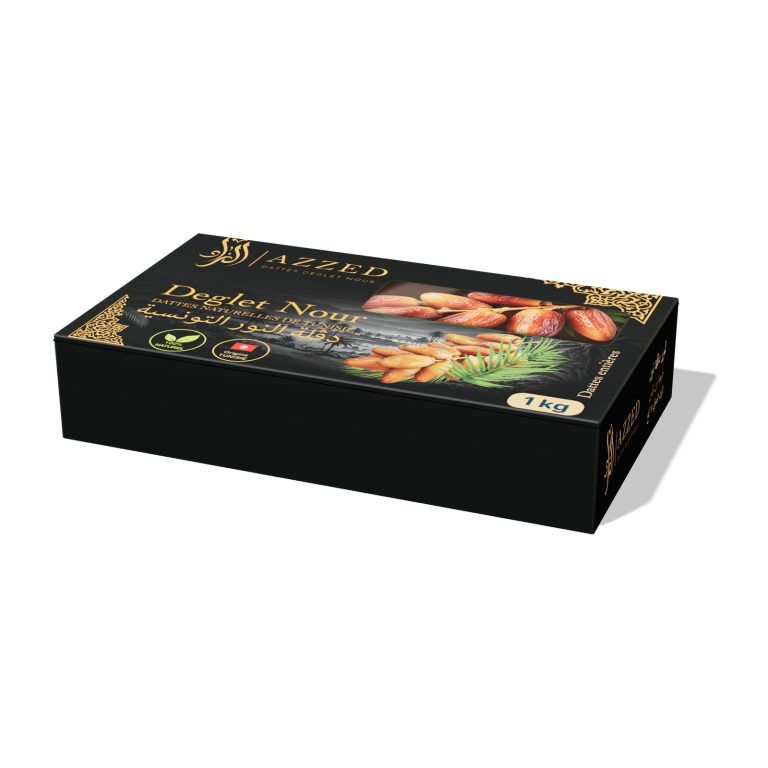
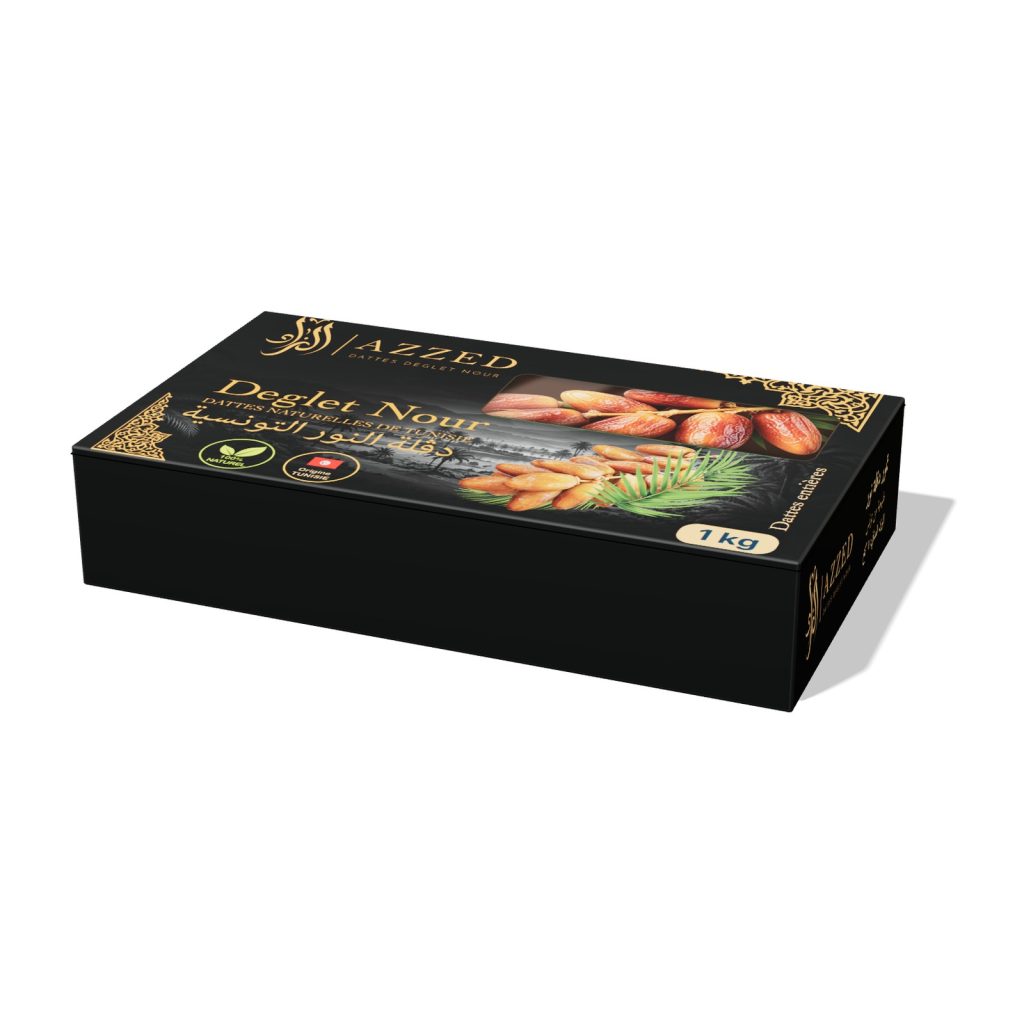
- Retail boxes, such as the Azzed 1 kg box shown on this page, mean more packaging material per kilogram, more packing time and more outer cartons to protect them. In return, they are ready for the shelf.
Neither is “better”. The right choice depends on whether you repack at destination, sell loose or need a finished consumer product.
Outer cartons and pallets
The strength of outer cartons, the number of units per carton and whether goods are palletised all have a cost. They also protect your goods. Saving on carton quality to lower a quote can be a false economy if dates arrive crushed or exposed to moisture.
Labelling and private label
Standard labelling is one thing. Specific mentions in your language, your own design or a private-label pack are another: they require preparation, materials and often longer lead times. In most markets, the importer is responsible for label compliance, so confirm your requirements with your authority or customs broker and include them in your request, rather than discovering them after the price is fixed.
Lever 4: the Incoterm, freight and insurance
The Incoterm defines where the supplier’s responsibility ends. It is the single line that changes a quote the most, because it decides which costs are included.
- A quote at the supplier’s premises or handed to your carrier in Tunisia includes only the goods and the agreed handling. You pay freight, insurance and everything after that point.
- A quote delivered to your port or to your door includes freight, and sometimes insurance, and therefore looks higher. It is not more expensive; it simply includes more.
The practical consequence is simple: never compare quotes on different Incoterms without converting them first. If one supplier quotes at origin and another quotes delivered to your port, add your forwarder’s freight and insurance estimate to the first before deciding.
Two related points:
- Who organises transport matters. If you have your own forwarder, a quote at origin may suit you. If not, a supplier who arranges transport to an agreed point may save you time, even if the quote is higher on paper.
- Insurance is not automatic under every term. Check who covers the goods in transit and on what basis.
We explain each common Incoterm in plain language in Shipping Tunisian Dates Abroad. Here, the key message is only this: the Incoterm is a lever, and it must be the same on every quote you compare.
Lever 5: season, new crop or stored stock
Dates follow the harvest calendar. Deglet Nour is generally harvested in the autumn and early winter, and demand rises before Ramadan and the year-end holidays.
How the season moves a quote:
- New crop at harvest time is the moment when the widest choice of fruit is available, but also when packing houses and transport are busiest. Requests placed early in the season usually get more options.
- Stored stock later in the year has been kept in cold storage, which has a cost, and the choice of grades and forms may be narrower. The fruit can remain very good if storage has been done well, but you should ask about it.
- Peak periods before major festive seasons put pressure on packing capacity and freight. Ordering close to a peak can mean fewer options and tighter schedules.
A quote for agricultural goods also has a validity period. Availability and costs move during the season, so a price given in one month may be revised later. Always check how long a quote holds. For a month-by-month view, read The Tunisian Deglet Nour Year for Importers and, if you are preparing a festive range, Planning Your Ramadan 2027 Date Stock.
Lever 6: order size and regularity
Volume matters, but perhaps not in the way buyers expect.
- Fixed costs are spread over the order. Preparing documents, organising loading and setting up a packing run take roughly the same effort whether the order is small or large. On a small order, these costs weigh more per kilogram.
- Regularity can matter as much as size. A buyer who orders modest quantities on a predictable schedule allows a supplier to plan packing and stock. That planning has value, and it can be reflected in the conditions offered.
- Mixed orders combining several forms in one shipment are practical for testing a market, but each additional product line means more preparation. Our guide Building a Mixed First Order explains how to keep a mix simple.
The most useful thing you can do on this lever is to be honest about your size. State your first volume clearly, say whether it is a trial, and give a realistic idea of how often you expect to reorder. Overstating volumes to get a better quote tends to create disappointment on both sides when the real order arrives.
Lever 7: documents
Every export shipment travels with paperwork, and some documents involve fees, inspections or administrative time. Buyers commonly ask for a commercial invoice, a packing list, a certificate of origin, a phytosanitary certificate where the destination requires it and, for many EU-bound shipments, a proof of preferential origin such as the EUR.1.
How documents move a quote:
- Each document has a cost, in time or in fees, and a quote that includes them is not directly comparable with one that does not.
- Specific requirements from your market, such as additional analyses or particular wording, may add steps. They should be known before the price is fixed.
- Missing documents cost far more later than they would have cost at the quote stage, because goods can be delayed at the border.
Ask your customs broker which documents your market requires, list them in your request, and check that every quote states which ones it includes. This is general information, not legal advice: requirements depend on your country and change over time.
Lever 8: payment terms
Payment terms are part of the price, even when they are not written in the same column.
- Who carries the risk and the cash changes with the terms. Payment before shipment, a deposit with a balance on documents, or other arrangements each place a different burden on the seller or the buyer.
- Currency affects the quote. A supplier quoting in a currency other than its own carries exchange risk, which may be reflected in the price or in the validity period.
- Bank and transfer costs exist on both sides. Agree in writing who pays which charges.
For a first order, it is common for a supplier to ask for conditions that limit its risk with a new buyer. As trust builds over several orders, terms are often discussed again. Whatever you agree, put it in writing, and always confirm bank details by phone with a person you know before sending money.
The levers at a glance
The table below summarises each lever, the direction in which it tends to move a quote, and what to state in your request. It describes general tendencies, not fixed rules: every supplier and every season is different.
| Lever | Tends to raise the quote | Tends to lower the quote | What to state in your request |
|---|---|---|---|
| Product form | Branch dates, Arjoun, pitted dates | Loose standard dates | Exact form(s) and whether pitted is needed |
| Sorting and grade | Very uniform, tightly sorted fruit | Broader specification suited to the use | Appearance, texture, tolerance, intended use; samples as reference |
| Packaging | Retail boxes, private label, specific labelling | Bulk cartons for repacking or loose sale | Unit format, outer carton, pallets, label language |
| Incoterm | Delivered terms including freight and insurance | Terms ending in Tunisia | The same Incoterm for every supplier, or two to compare |
| Season | Late-season stored stock, orders near peaks | Requests placed early in the harvest | Desired crop and delivery window |
| Order size and regularity | Very small one-off orders, many product lines | Regular, predictable orders, simple mix | First volume, frequency, realistic annual outlook |
| Documents | Additional analyses or specific requirements | Only the documents your market requires | Full list confirmed by your customs broker |
| Payment terms | Long credit, foreign currency risk carried by seller | Terms that limit risk for both sides | Currency, method, timing, who pays bank charges |
Read this table as a set of trade-offs, not as a shopping list for the lowest price. The cheapest combination is rarely the one that sells best in your market.
How to get quotes you can actually compare
The aim of understanding the levers is not to negotiate harder. It is to receive quotes that describe the same thing. A few habits make that much easier:
- Fix the levers before you ask. Decide on form, grade description, packaging, Incoterm, delivery window and documents, or explicitly ask each supplier to suggest an option.
- Send the same request to every supplier. If you change one detail for one supplier, their quote is no longer comparable.
- Ask for a breakdown. You do not need every cost line, but you should see what the price includes: product, packaging, documents, transport up to which point, and validity.
- Ask for samples of the quoted product, not of a better product. The samples should match the grade and form in the quote.
- Check the validity period and lead time. A low price that expires in a few days or cannot be shipped in your window is not useful.
- Compare total landed cost, not the line on the quote. Add freight, insurance, duties and local handling as your forwarder and broker estimate them.
Our RFQ checklist gives you a ready-to-copy table that covers all of these points.
Common misreadings of a date quote
“This supplier is much cheaper”
Check the Incoterm, the form, the packaging and the documents first. In many cases, the “cheaper” quote simply includes less.
“Branch dates should cost the same as standard dates”
Branch dates involve more careful handling and take more space. A difference is normal.
“The price should stay the same all year”
Dates are seasonal. Availability, storage and freight move during the year, and so do quotes.
“A bigger first order will always get a better price”
Volume helps, but regularity and an honest, well-specified request often help just as much. A clear small order is easier to quote well than a vague large one.
“Documents are a formality”
They are part of the cost and part of the risk. A quote without the documents your market requires is incomplete.
How Azzed prepares an export quote
Azzed is a Tunisian Deglet Nour brand from the oases of Douz and Kébili, in the Nefzaoua region of southern Tunisia. We are not a large exporter and we do not claim to be. We are building our export activity step by step, with small and mid-sized buyers such as importers, specialty grocers, retailers and mid-sized wholesalers.
When you send us a request, this is how we work:
- We study every request, including trial orders. A small, clear request is welcome.
- We quote for all our products: standard dates, branch dates, Deglet Nour Arjoun and pitted dates on request. The full range is on our Products page.
- We tell you which levers apply. If a packaging format, a document or a delivery window changes the quote, or is not realistic for us, we say so in our reply.
- We do not publish a price list for export, because the levers described in this article make every request different. A quote built on your actual specification is more useful than a generic figure.
You can learn more about how we select and handle our dates on our Quality page, and about our approach to buyers abroad on our Export page.
Frequently Asked Questions
Why don’t Tunisian date suppliers give a single price per kilogram?
Because the price depends on the form, grade, packaging, Incoterm, season, volume, documents and payment terms. A single figure without those details would not describe what you will actually receive.
Which lever changes a quote the most?
It depends on the request, but the Incoterm and the packaging format are often the two that create the largest gaps between quotes. Make sure they are identical before comparing.
Are branch dates and Arjoun always more expensive than standard dates?
They generally involve more handling and more space, so they tend to be quoted higher. Whether they are worth it depends on your customers: for gifting, displays and festive seasons, presentation often matters.
Can I lower a quote without lowering quality?
Often, yes. Choosing bulk cartons instead of retail boxes if you repack, ordering early in the season, keeping a simple product mix and committing to a regular schedule can all help, without changing the fruit itself.
How long is an export quote for dates valid?
It varies by supplier and season, because availability and costs move during the year. Always ask for the validity period and confirm the price before placing the order.
Does Azzed quote small orders?
Yes. We study every request, including trial orders from small and mid-sized buyers, and reply with what is realistic for your volume.
How do I request a quote from Azzed?
Use our contact form or message us on WhatsApp at +216 52 146 101. State the levers you have already decided and ask us to suggest options for the others.
Further reading
Conclusion
An export quote for Tunisian Deglet Nour moves with eight levers: product form, sorting and grade, packaging, Incoterm, season, order size and regularity, documents and payment terms. None of them is hidden. Once you name each one in your request, quotes stop being mysterious numbers and become clear descriptions of what you are buying, which you can compare line by line and adjust to your market.
If you want a quote built on your real specification, from a local Tunisian brand that welcomes small and mid-sized buyers, we would be glad to hear from you. Request a quote, visit our Export page, or message us on WhatsApp at +216 52 146 101.
Read next: How to Write a Request for Quotation for Tunisian Dates