
Summary
- In a delicatessen or specialty grocery, Tunisian Deglet Nour sells best when it is presented as a product with a story: a named variety, a named origin (the oases of Douz and Kébili, in southern Tunisia) and a clear way to eat it.
- Each presentation has a role on the shop floor: branch dates attract the eye and work as a display product, standard dates in boxes are the everyday purchase, and the Arjoun (the whole bunch) is a centrepiece for events and special orders.
- Customers ask the same handful of questions: where the dates come from, which variety it is, how to store them and how Deglet Nour differs from Medjool. A short, ready answer for each one makes the sale easier.
- Dates keep well, but they still need cool, dry storage, first-in, first-out rotation and attention to humidity and direct sunlight on the shelf.
- The strongest selling moments are usually Ramadan and the year-end holidays, with the new harvest in autumn as a natural launch.
- To test the product, start with a small first order by quote. At Azzed, we study every request, including small ones: request a quote or message us on WhatsApp at +216 52 146 101.
Why Deglet Nour fits a specialty grocery
Specialty shops do not win on price alone. They win on selection, on knowledge and on the feeling that each product on the shelf was chosen for a reason. Tunisian Deglet Nour fits that logic well.
First, it is a named variety with a recognisable look. Deglet Nour dates are slender, with a translucent amber colour when held to the light, and a semi-soft texture that is less sticky than many other dates. Customers who only know “dates” as a generic sticky block in a plastic tray often discover that a variety can have its own character.
Second, it comes from a specific place. Tunisia is one of the world’s major date producers, and Deglet Nour is its best-known variety. Azzed dates come from the oases of Douz and Kébili, in the Nefzaoua region at the edge of the Sahara. A product that can be traced to a region, and not just to a country, gives your staff something concrete to say.
Third, it is versatile. The same fruit is eaten on its own, served with coffee or tea, stuffed, chopped into salads and grain dishes, or used in baking. That versatility lets you place dates in more than one corner of the shop and talk to more than one type of customer.
If you are still deciding whether Deglet Nour belongs in your range at all, our guide Deglet Nour vs Medjool: Which Dates Should Your Store Carry? compares the two varieties from a retailer’s point of view. This article assumes you have decided to try Deglet Nour and focuses on what happens in the shop.
Three presentations, three roles on the shop floor
Azzed offers Deglet Nour in several presentations. For a specialty retailer, each one does a different job. Our guide Deglet Nour Grades Explained describes the products in detail; here is how they work in a store.
Branch dates: the display product
Branch dates are dates still attached to their strands, as they were cut from the palm. They look exactly like what they are: fruit from a tree. That is their strength in a shop.
- Use them to catch the eye. A basket or a wooden crate of branch dates near the entrance or the till tells customers immediately that you carry a product from the source.
- Sell them by weight or in a simple wrap. Customers often like to choose a strand themselves. If you sell loose, provide tongs or gloves and a clear price per kilogram.
- Tell the story on a small card. “Deglet Nour dates on the branch, from the oases of Douz and Kébili, southern Tunisia” is enough. Short and precise works better than long and vague.
Branch dates are often what customers photograph and remember. Even if a larger share of your volume ends up being boxed dates, the branch display can be what brings people to the shelf.
Standard dates in boxes: the everyday purchase
Standard dates are loose Deglet Nour, detached from the strand. In a specialty store, they are the product people take home week after week.
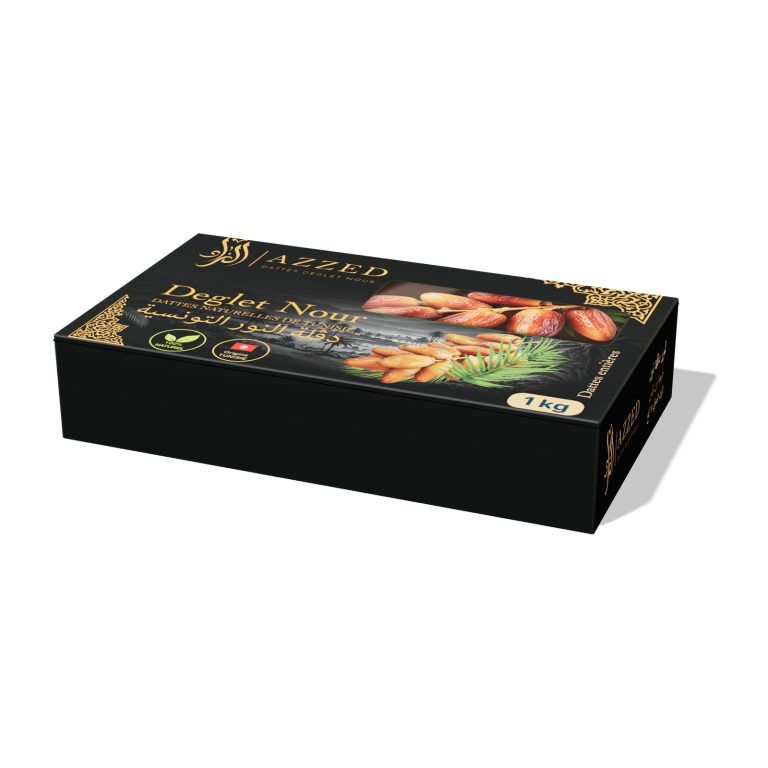
- Boxes make the purchase easy. A closed box is quick to pick up, easy to stack and simple to price. Azzed packs Deglet Nour in boxes, and other packaging formats can be discussed in your quote.
- Place them where people shop for related products. Next to dried fruit and nuts, near coffee and tea, or close to the baking shelf.
- Use an open tasting dish if your local rules allow it. For a product many customers have never tried as a named variety, tasting usually does more than any label.
Arjoun: the event piece
The Deglet Nour Arjoun is the whole bunch, as harvested. It can weigh up to about 20 kg. It is not an everyday shelf product, and it is not meant to be.
- Offer it for events and special orders: a family celebration, a community iftar, a store opening, a tasting evening or a corporate reception.
- Show it once, sell it by order. A photo at the counter, or a single bunch displayed for a few days during a seasonal peak, can generate orders without tying up stock.
- Plan ahead. Because it is a large, specific item, the Arjoun is supplied on quote and needs more lead time than boxed dates.
Pitted dates on request
Some customers want dates ready for cooking or for children’s lunch boxes. Azzed can supply pitted Deglet Nour on request. If your clientele includes many home bakers or cooks, mention it in your quote request and see whether it makes sense for your first order.
The questions your customers will ask
The best date displays come with staff who can answer a few simple questions in one or two sentences. The table below gives you short answers you can adapt for your team or for shelf cards.
| Customer question | Short answer for staff | Where to place the answer |
|---|---|---|
| Where do these dates come from? | From the oases of Douz and Kébili, in the Nefzaoua region of southern Tunisia. | Shelf card, product sign |
| What variety is it? | Deglet Nour, the best-known Tunisian variety. Slender, amber, semi-soft, with a honey-like sweetness. | Shelf card |
| How is it different from Medjool? | Medjool is larger and softer, very sticky. Deglet Nour is slimmer, firmer and less sticky, easy to eat by hand and to cook with. | Staff briefing, tasting table |
| Why are some dates still on the branch? | They are branch dates, sold on the strand as harvested. The fruit is the same Deglet Nour. | Next to the branch display |
| How should I store them at home? | In a cool, dry place, in a closed box or jar once opened. In warm weather the fridge helps. Follow the date on the pack. | Shelf card, receipt insert |
| Do you have them without the stone? | Pitted Deglet Nour can be ordered on request; check what is on the shelf this week. | Counter sign |
| How do I eat them? | On their own, with coffee or tea, stuffed with nuts or cheese, chopped into salads, or in baking. | Recipe card, tasting table |
| Can I order a large quantity? | Yes, by special order for boxes or a whole Arjoun bunch. Ask at the counter. | Counter sign |
Origin: be precise, not grand
“From Tunisia” is good. “From the oases of Douz and Kébili, in southern Tunisia” is better, because it is specific and checkable. Avoid inventing details you cannot confirm, such as the age of the palms or the name of a farm. A specialty customer values precise information more than impressive adjectives.
Variety: give customers a picture
Most people cannot describe a Deglet Nour, but they understand comparisons. “Slimmer and less sticky than a Medjool, with a lighter, honey-like taste” gives them a picture in one sentence. For a fuller comparison to share with your staff, see Deglet Nour vs Medjool.
Storage at home: keep it simple
Customers often ask whether dates must go in the fridge. A simple, honest answer: a cool, dry cupboard is fine for a while; a closed container keeps them from drying out or absorbing smells; in a warm, humid kitchen, the fridge is a good idea. Always point to the best-before date on the pack rather than promising a number of weeks or months yourself.
Medjool vs Deglet Nour: avoid the “better or worse” trap
Some customers arrive convinced that one variety is superior. The most useful answer is that they are different: Medjool for those who want a large, very soft date; Deglet Nour for those who prefer a slimmer, firmer fruit that is easy to snack on and to cook with. Offering both, or a tasting of both, often sells more than arguing for one.
Shelf rotation and storage in the shop
Dates are a robust product compared with fresh fruit, but they are not indestructible. Their quality on the shelf depends largely on how you store and rotate them.
In the back room
- Keep cartons in a cool, dry place, away from heat sources, ovens, windows and outside walls that warm up in the sun.
- Avoid humidity. Damp storage can make dates sticky and affect the packaging; very dry, warm air can dry them out.
- Store away from strong smells. Dates can pick up odours from spices, cleaning products or coffee roasting.
- Keep cartons off the floor and do not crush them under heavier goods.
If you receive a larger order or plan seasonal stock, our article Storing Deglet Nour Dates in an Importer Warehouse goes into storage conditions in more depth.
On the shelf
- First in, first out. Put new stock behind older stock, and check best-before dates every time you refill.
- Keep displays out of direct sunlight. A sunny window looks attractive but warms the fruit and fades packaging.
- Refill branch displays little and often. A small, fresh-looking display sells better than a large one that looks tired by the end of the week.
- Cover open tasting dishes and replace their content regularly.
Watching what sells
A first order is an experiment. Note, week by week, which presentation moves, at what moments and to which customers. After one season you will know whether your shop is a “branch dates” shop, a “boxes” shop or a mix, and you can adjust your next quote request accordingly. Our article Building a Mixed First Order of Tunisian Dates to Test Your Market explains how to structure that test.
Seasonal moments to plan for
Dates sell all year in a specialty store, but some periods matter more than others.
New harvest in autumn
The Deglet Nour harvest in Tunisia generally runs from October to December. “New harvest” is a simple, honest message for a shelf card, and it gives you a natural moment to introduce the product. For the full calendar, see The Tunisian Deglet Nour Year for Importers.
Year-end holidays
In many countries, dates are part of year-end tables, gift baskets and hosting. Boxed Deglet Nour fits naturally in gift selections next to nuts, chocolate and dried fruit, and a branch display adds a festive touch to the shop.
Ramadan
Dates are traditionally eaten to break the fast during Ramadan. Ramadan 2027 is expected to begin around 8 February 2027, subject to moon sighting. For stores serving customers who observe Ramadan, this is often the most important date season of the year: boxes for families, branch dates for presentation and, for community events, the Arjoun. Plan your order well before the peak; our article Planning Your Ramadan 2027 Date Stock gives a timeline.
Tastings and local events
Outside these peaks, a tasting day, a cooking demonstration or a “taste of Tunisia” week can revive interest. Dates pair well with cheese, coffee, tea and nuts, which makes them easy to include in events you may already run.
Sourcing a first small order from Azzed
Azzed is a Tunisian Deglet Nour brand from the oases of Douz and Kébili. We are not yet a large exporter, and we do not claim to be. What we offer specialty retailers abroad is simple: we study every request, including small first orders, and we quote for all our products.
What you can request
- Standard dates, whole, in boxes or other formats to be discussed;
- Branch dates for your display;
- Deglet Nour Arjoun, the whole bunch, for events or special orders;
- pitted dates on request.
The full range is on our Products page, and our approach is described on the Quality and Export pages.
What to tell us in your request
A specialty grocery does not need a long document. A short message with the essentials is enough:
- Who you are: shop name, city and country, type of store.
- What you want to test: which presentations, and roughly how much of each.
- Packaging and labelling needs: box format, language of the labels, whether you add your own sticker.
- Destination and transport: your address or forwarder, and the Incoterm you prefer, or “please suggest”.
- Timing: when you would like the goods in your shop, and why (new harvest, year-end, Ramadan).
- Documents: the list your customs broker or importer has given you.
For a ready-to-use template, see How to Write a Request for Quotation for Tunisian Dates. If transport and paperwork are new to you, read Shipping Tunisian Dates Abroad before you write.
Working through an importer
Many specialty stores do not import directly. They buy through a local importer or distributor who handles customs and transport. If that is your case, you can still contact us: share your project, and your importer can request the quote and organise the shipment. What matters to us is understanding the final use, so that we suggest the right presentation and packaging.
Samples first
Before committing shelf space, taste. Ask about samples in your first message, and compare them with what you currently sell. Our guide Evaluating Deglet Nour Samples Before a First Order explains what to look at: colour, texture, moisture, uniformity and taste.
Common mistakes when introducing dates in a specialty store
- Hiding the product. Dates placed on a low shelf with no sign rarely sell. Give them a visible spot and a short story.
- Generic labelling. “Dates” says nothing. “Deglet Nour, southern Tunisia” gives customers a reason to choose.
- Overstocking the first time. A small, mixed test teaches you more than a large single-product order you will struggle to rotate.
- Ordering too late for Ramadan. Lead times before the peak are longer. Plan weeks in advance.
- Claims you cannot support. Only write on your shelf cards what you can confirm from the product label and the supplier’s written specification.
- Forgetting the back room. Good dates stored next to a radiator will disappoint, whatever their origin.
Frequently Asked Questions
Is Deglet Nour a good choice for a small specialty grocery?
It can be. It is a named variety with a clear origin, easy to explain and versatile in use. The best way to know whether it suits your customers is a small first order and a tasting.
Which presentation should I start with?
Many shops start with standard dates in boxes for regular sales and a small amount of branch dates for display. The Arjoun can be offered by special order once you know there is demand for events.
Can I order a small quantity from Azzed?
Yes. We study every request, including small first orders, and reply with what is realistic for your volume. Send us your project through our contact form.
How should dates be stored in the shop?
In a cool, dry place, away from direct sunlight, heat and strong smells, with first-in, first-out rotation and regular checks of best-before dates.
When should I order for Ramadan?
Well before the peak. Ramadan 2027 is expected to begin around 8 February 2027, subject to moon sighting, so planning your quote request in the autumn gives you more options. See Planning Your Ramadan 2027 Date Stock.
Can I get samples before ordering?
Ask for them in your first message. Samples help you and your staff taste the product and prepare the answers your customers will expect.
How do I contact Azzed?
Use our contact form or send a WhatsApp message to +216 52 146 101.
Further reading
Conclusion
Selling Tunisian Deglet Nour in a specialty grocery is less about volume and more about presentation and knowledge. Give each product a role: branch dates to attract the eye, boxed standard dates for everyday purchases, the Arjoun for events. Prepare short, precise answers about origin, variety, storage and Medjool. Store and rotate the fruit carefully, and plan around the new harvest, the year-end holidays and Ramadan.
Then start small. A first order built for testing tells you what your customers really want before you commit to larger volumes. If you would like to try Deglet Nour from the oases of Douz and Kébili in your shop, request a quote, visit our Export page, or message us on WhatsApp at +216 52 146 101. We will read your request carefully and tell you honestly what we can do.
Read next: Building a Mixed First Order of Tunisian Dates to Test Your Market