
Summary
- A supermarket or regional chain buyer is managing a category, not buying a product. They think in terms of range reviews, seasonal slots, shelf space, sell-through and supply reliability. A good pitch answers those concerns before they are raised.
- Prepare a complete file before the meeting: a product sheet, samples, pack formats and sizes, barcodes and labelling in the destination language, case and pallet configuration, and a clear price structure. This guide explains each element without any figure.
- Seasonal programmes are often the easiest way in. Ramadan moves earlier each year and the year-end brings festive demand: buyers plan both well ahead of the shelf date.
- Retailers set their own requirements (food-safety audits or standards, insurance, logistics and delivery windows). The retailer will tell you which apply; ask your supplier what documents they can provide, and never assume.
- Starting small with a regional chain or a trial listing is usually more realistic than aiming for a national range at once.
- Align with your supplier before promising volumes: consistency, lead times and a reference sample are agreed in the quote. To discuss a supply plan, request a quote or message us on WhatsApp at +216 52 146 101.
Why a supermarket listing is a different kind of sale
Selling Tunisian Deglet Nour to a delicatessen, a wholesale market trader or a web shop is mostly a conversation about the product: how it looks, how it tastes, how it sells. Selling to a supermarket or a regional retail chain is also a conversation about systems. The buyer you meet is responsible for a whole category (dried fruit, nuts, snacks or a seasonal aisle) and has to justify every line in it. Your dates will compete for space not only with other dates, but with every product that could occupy the same shelf.
A beautiful sample is therefore necessary but not enough. The buyer also wants to know whether the product will arrive on time, in the right cases, with the right labels, at a price structure that works for the chain, and whether it will still be available next season.
This guide is written for small and mid-sized importers and brand owners who want to get Tunisian Deglet Nour listed by a supermarket or regional chain buyer. It does not repeat our other retail guides, which you can read alongside it:
- smaller independent shops are covered in Selling Tunisian Deglet Nour in a Specialty Grocery;
- wholesale channels are covered in Selling Tunisian Deglet Nour Through Wholesale Markets and Cash & Carry;
- launching a product with tastings is covered in In-Store Tasting and Launch;
- pack and label design is covered in Retail Packaging and Labelling;
- writing a product specification is covered in The Deglet Nour Product Specification Sheet;
- organising repeat supply over a year is covered in An Annual Supply Programme.
Here the focus is on the pitch itself.
How category buyers usually think
Every retailer has its own processes, but a few concerns come up almost everywhere.
Range reviews
Many chains review each category at set moments, deciding which products stay, which leave and which new lines come in. Outside those windows, a new product is hard to get considered unless it fills a gap or fits a seasonal programme. Ask early when the next review is planned, and present before decisions are made.
Seasonal slots
Besides the permanent range, many retailers run seasonal displays: a festive aisle at the year-end, a dedicated area before Ramadan, promotional ends of aisle. These slots are planned well in advance and are often easier to obtain for a new supplier than a permanent listing, because the commitment is limited in time.
Shelf space and sell-through
Shelf space is the buyer's scarcest resource. A product earns its place by selling. Buyers usually look at how fast a line moves compared with the others in its category, and at whether it brings new shoppers or simply takes sales from an existing product. In your pitch, explain who your Deglet Nour is for and why it adds something to the range (origin, format, seasonal relevance), rather than claiming it will outsell everything else.
Supply reliability
For a chain, an empty shelf means lost sales and extra work for store teams. A small importer can reassure the buyer with a clear supply plan, honest lead times and realistic volumes. Over-promising is the fastest way to lose a listing.
What to prepare before the meeting
A complete file shows that you understand retail and saves the buyer time. The elements below are the usual core; the retailer may ask for more.
A product sheet
A short product sheet summarises what the buyer needs at a glance:
- product name and variety (Deglet Nour), origin (southern Tunisia; for our dates, the oases of Douz and Kébili);
- product form: standard dates, branch dates, pitted on request, and whether the dates in a pack are whole with the stone;
- pack formats and net weights you propose;
- storage advice and date marking approach;
- case and pallet configuration;
- a short description of the product's appearance, texture and taste in plain words;
- your company details as importer or brand owner.
Behind the product sheet, keep a fuller product specification sheet agreed with your supplier. The buyer may ask for it, and it will be the reference at every delivery.
Samples
Bring samples that are representative of what you will actually deliver: the same form, the same pack and, as far as possible, the same crop. A sample that is better than the regular product creates expectations you cannot meet. Our guide on evaluating Deglet Nour samples explains how to select and keep reference samples. If the buyer wants to compare, be ready to explain the difference between Deglet Nour and other varieties without criticising anyone; our Deglet Nour vs Medjool article helps here.
Pack formats and sizes
Supermarkets usually want consumer packs that fit their shelves and their shoppers' habits. Think about:
- a core everyday pack of standard dates;
- a display or festive pack, for example branch dates, for seasonal slots;
- how the pack looks on a shelf among other dried fruit: front facing, readability, stability.
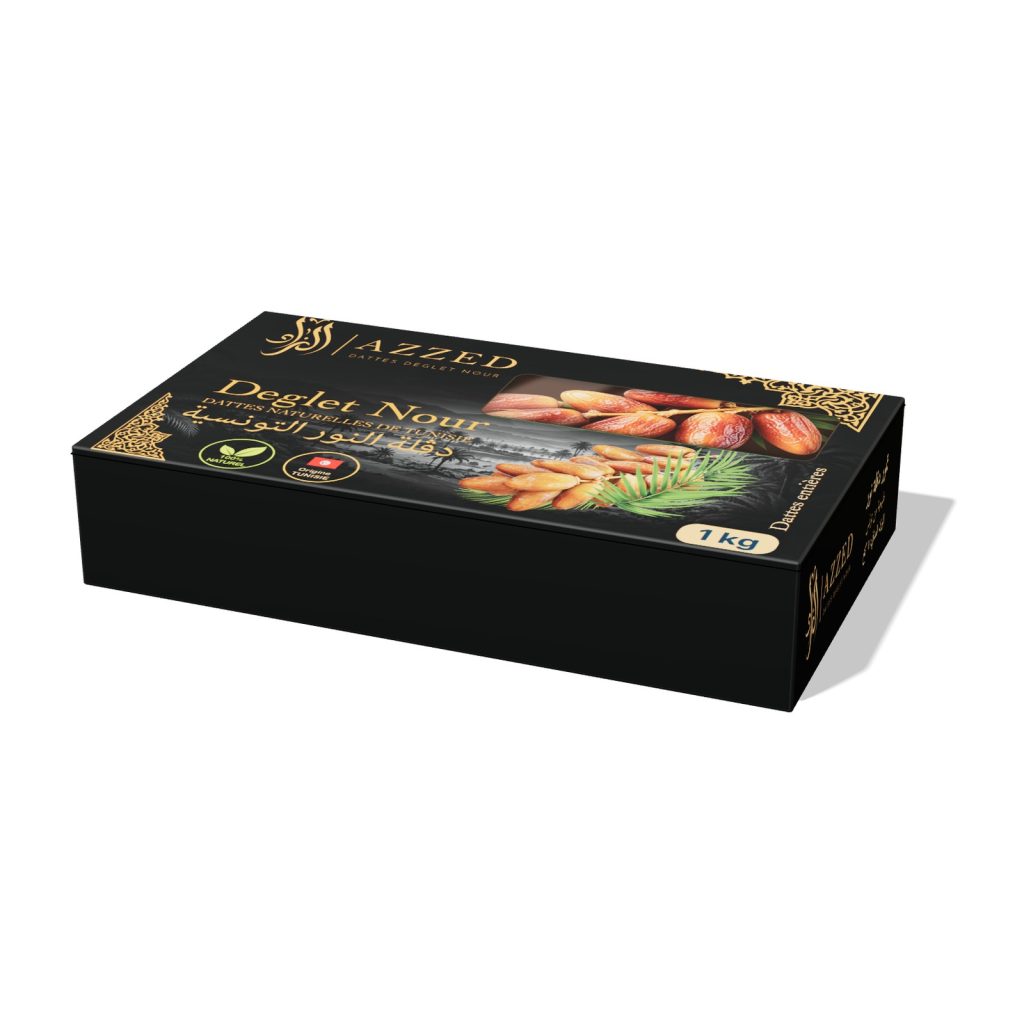
Fewer, well-chosen formats are usually easier to list than a long range. Who packs the consumer pack (the supplier at origin or a packer in your country) has consequences for cost, labelling and lead time; it is a point to discuss case by case in the quote.
Barcodes and labelling in the destination language
Retailers generally expect each consumer unit to carry a barcode that their tills can read, and outer cases to carry their own codes. They also expect the label to meet the rules of the destination market, in the required language or languages: product name, net quantity, origin, storage advice, date marking, importer or brand owner details and other mandatory items. These rules vary by country and change over time. Check them locally before any artwork is printed, and agree who prepares and approves the artwork. Our retail packaging and labelling guide covers the general points.
Case and pallet configuration
The chain's warehouse needs to know exactly what it will receive:
- number of consumer units per case;
- case dimensions and gross weight;
- number of cases per layer and layers per pallet;
- pallet type and how the pallet is wrapped and labelled.
Changing this configuration after listing usually means extra work on both sides, so get it right at the start.
A clear price structure
Buyers expect a price that is easy to read and easy to compare. In general terms, prepare:
- your price per case and per unit, on the delivery basis the retailer uses (to their warehouse, for example);
- what the price includes: transport to the agreed point, labelling, any display material;
- how long the price is valid and how it may be reviewed (for example at each new crop);
- any seasonal or promotional support you are prepared to discuss, described in words rather than promised as a number in the first meeting.
To build this structure, start from your full landed cost, as explained in Landed Cost for Importers of Tunisian Dates. On the supplier side, our article on what moves an export quote explains the levers that affect the price you pay. The chain may also have its own commercial conditions; listen carefully and do not agree to anything you have not costed.
The pitch checklist
The table below summarises what to prepare, why the buyer cares, and what to align with your supplier before the meeting.
| Element | What to prepare | Why the buyer cares | What to agree with your supplier first |
|---|---|---|---|
| Product sheet | Variety, origin, form, packs, storage, case and pallet data | Quick decision, internal approval | Wording on origin, form and crop |
| Specification | Full spec sheet with qualitative tolerances | Consistency at every delivery | Spec confirmed in writing and quoted |
| Samples | Representative samples of each proposed pack | Taste, look, comparison with the range | Reference sample kept on both sides |
| Pack formats | A short range: everyday pack, seasonal pack | Shelf fit and shopper appeal | Who packs, which formats are feasible |
| Barcodes and labels | Unit and case codes, label in destination language | Till scanning, legal compliance | Who prepares and approves artwork |
| Case and pallet | Units per case, case size, pallet pattern | Warehouse handling | Carton type and packing method in the quote |
| Price structure | Price per case and unit, basis, validity, review rule | Fit with price architecture and margin | Supplier price, validity and review agreed |
| Seasonal programme | Proposed timing for Ramadan and year-end | Planning of seasonal slots | Lead times and production window |
| Retailer requirements | List of audits, standards, insurance, logistics asked | Risk management | Which documents the supplier can provide |
| Supply plan | Realistic volumes, delivery rhythm, contingency | Avoiding empty shelves | Volumes and timing the supplier can commit to |
Use it as a working document and update it after every exchange with the buyer or the supplier.
Seasonal programmes: often the easiest way in
For a new supplier, a seasonal programme can be a more accessible first step than a permanent listing. It lets the buyer test your product with limited risk, and it lets you test your supply chain on a defined volume.
Ramadan
In many markets with Muslim communities, the period before and during Ramadan is a key moment for dates. Ramadan follows the lunar calendar and moves earlier each year in the Gregorian calendar; in 2027 it is expected to begin around mid-February. Retail buyers plan seasonal displays well before the shelf date, and goods often have to reach the retailer's warehouse some time before the display goes up. Work backwards from the start of Ramadan to set the date of your pitch, the date of the order and the date of shipment. Our guide on planning Ramadan 2027 date stock helps with this reverse planning.
Year-end
In many countries, the end of the year brings festive tables, hosting and gifts. Branch dates and attractive consumer packs can find a place in festive aisles. If you are thinking of gift formats, see Tunisian Date Gift Boxes for Seasonal Gifting.
New crop
The Deglet Nour harvest in southern Tunisia generally runs from autumn into early winter. New-crop fruit is a natural talking point with a buyer, and it gives you a reason to propose a review of the product and the price each season. Our harvest calendar for importers explains the timing.
Requirements a retailer may set
Supermarket and retail chains usually have supplier requirements that go beyond the product itself. They differ from one retailer to another and from one country to another, so no general list can replace what the buyer tells you. Common areas include:
- Food-safety audits or standards. Many retailers ask suppliers to meet a food-safety standard or to accept an audit of the site where the product is packed. The retailer will tell you which standard or audit applies.
- Product liability insurance. Retailers often expect the importer or brand owner to hold appropriate insurance. Check with your insurer what is needed.
- Traceability. The ability to trace a lot from the shelf back to its origin, usually through lot codes on cases and units.
- Logistics and delivery windows. Deliveries to a distribution centre often have to be booked in advance, within set time slots, with specific paperwork and pallet labels.
The rule here is simple: the retailer will tell you which requirements apply; ask your supplier what documents they can provide, and never assume. Do not tell a buyer that a document exists, or that an audit can be arranged, until your supplier has confirmed it in writing. If a requirement cannot be met at origin, discuss with the buyer whether another arrangement is acceptable, for example a packer in your country who meets the retailer's conditions. Our supplier due diligence checklist explains how to ask these questions in a structured way.
Starting with a regional chain or a trial listing
Many small importers dream of a national listing. In practice, starting smaller is often more realistic and less risky.
Regional and independent chains
Regional chains, cooperatives and groups of independent supermarkets often have shorter decision paths and more room for specialist products: a good place to prove sell-through and test your supply chain.
Trial listings
Some retailers accept a trial listing: a limited number of stores, a limited period, or a seasonal slot only. Agree in advance how the trial will be judged (sell-through, availability, feedback from stores) and what happens next if it goes well. A trial is also a test for you: it shows whether your volumes, lead times and logistics work in real conditions.
Learning before scaling
Before you approach a chain, it helps to know your market. Our guide on market research before importing Tunisian dates explains how to gather evidence of demand, and a mixed first order can help you test several forms before committing to one retail pack.
What to agree with your supplier before promising volumes
A retailer listing creates obligations: the product must be available, consistent and on time. Before you make any commitment to a buyer, make sure your supplier can support it. These points are agreed case by case in the quote.
Consistency
The product on the shelf in the second season must match the one the buyer approved. Agree a written specification and a reference sample kept by both sides. Inspect every arrival before it leaves for the retailer, as described in arrival inspection and quality claims.
Lead times
Ask your supplier how much time they need between order confirmation and readiness for shipment, for each product form and pack, and at each period of the year. Add transport, clearance and delivery to the retailer's warehouse. Our guide on shipping Tunisian dates for first-time importers explains the main steps. Share the full timeline with the buyer honestly.
Volumes
Do not promise the buyer a volume that your supplier has not confirmed. If the retailer expects regular deliveries over the year, discuss an annual supply programme with your supplier, with scheduled shipments and a review after each season.
Payment and documents
A retailer may pay on its own terms, which affects your cash flow. Make sure the payment terms you agree with your supplier leave you room to finance the stock. Our guide on payment terms for a first export order and our request for quotation guide help you set this up.
Common mistakes when pitching to retail buyers
- Pitching only the product, without the case, pallet, label and supply information the buyer needs to decide.
- Bringing samples better than the regular product, which leads to disappointment at the first delivery.
- Proposing too many formats, which splits volumes and complicates logistics.
- Promising documents, audits or volumes that the supplier has not confirmed in writing.
- Accepting commercial conditions without having costed them against your landed cost.
- Neglecting the second season: a listing is kept by repeating the first success, not only by obtaining it.
Frequently Asked Questions
When is the best moment to approach a supermarket buyer?
Usually before the range review for the relevant category, or well ahead of the seasonal programme you are targeting. Ask the buyer or the retailer's supplier contact when decisions are made, and plan your pitch accordingly.
Which Deglet Nour format should I propose first?
In general, a core everyday pack of standard dates is the most straightforward permanent listing, while branch dates suit seasonal displays. Keep the range short at the start and let sell-through guide the next step.
What should a product sheet for a retail buyer contain?
Variety, origin, product form, pack formats and net weights, storage advice, date marking approach, case and pallet configuration, a plain description of appearance and taste, and your company details. Keep a full specification sheet behind it.
Do I need barcodes before the first meeting?
Not always for a first conversation, but the buyer will usually need them before listing. Find out what the retailer expects and how barcodes are obtained in your country, and plan the artwork with that in mind.
What if the retailer asks for a food-safety audit or standard?
The retailer will tell you which requirement applies. Ask your supplier in writing what documents they can provide, and do not confirm anything to the buyer until you have that answer. If a requirement cannot be met at origin, discuss alternatives with the buyer.
Should I start with a national chain?
For a small importer, a regional chain, a group of independent supermarkets or a trial listing is often more realistic. It lets you prove sell-through and test your supply chain before approaching larger buyers.
Can Azzed supply retail packs for a supermarket programme?
Product forms, packs, cartons, labels, lead times, prices, Incoterm, documents and payment terms are all discussed case by case in the quote. Tell us what the retailer expects when you request a quote, and we will study the request.
Where do your dates come from?
Our Deglet Nour comes from the oases of Douz and Kébili, in the Nefzaoua region of southern Tunisia. See our Deglet Nour dates, grades guide and Quality pages.
Conclusion
Getting Tunisian Deglet Nour onto a supermarket or retail chain shelf is less about a single brilliant meeting and more about preparation. The method is practical: understand how category buyers think, arrive with a complete file (product sheet, representative samples, a short range of packs, barcodes and labels in the destination language, case and pallet data, a clear price structure), use seasonal programmes such as Ramadan and the year-end as an entry point, let the retailer state its requirements and check with your supplier before answering, start with a regional chain or a trial listing, and agree consistency, lead times and a reference sample with your supplier before promising any volume.
A buyer who sees that your promises are backed by a real supply plan is far more likely to give your product a chance, and to keep it on the shelf.
Azzed is a local Tunisian Deglet Nour brand from the oases of Douz and Kébili. We are still building our export activity, and we study every request from small and mid-sized buyers for all our products: standard dates, branch dates, the Arjoun and pitted dates on request. To prepare a supply plan for a retail project, request a quote, read our Export page, browse our Products, or message us on WhatsApp at +216 52 146 101.
Read next: Retail Packaging and Labelling for Tunisian Dates
