Summary
- Before asking for a price, decide where the retail pack will be made: at origin (retail-ready goods shipped from Tunisia) or in your own country (bulk cartons repacked by you or a packer). Each route moves cost, risk and lead time to a different place.
- A consumer label for dates usually carries the product name, variety, origin, net weight, a lot code, a best-before date, storage advice and the details of the business responsible for the product in your market, written in the language of the destination market. The exact list depends on your country: check your local rules.
- In most markets the importer or the brand owner is responsible for label compliance. The supplier packs to the specification you give; you confirm what the specification must contain.
- Private label (your brand on the pack) is possible to discuss, but at Azzed it is studied case by case in the quote, not offered as a standard menu.
- The most common delays come from artwork approval, printed materials and late changes. Raise these questions in your first message, not after the price is agreed.
- To discuss a retail project, request a quote or message us on WhatsApp at +216 52 146 101.
Why packaging is a decision, not a detail
Many importers start with the fruit and leave the pack for later. With dates, that order of thinking often creates problems. The same Deglet Nour can reach a shelf abroad in very different forms: a 1 kg box packed at origin, a smaller pack filled in your warehouse, a branch of dates displayed loose, or a gift presentation prepared for Ramadan or the year-end season. Each form changes:
- the price you are quoted, because packing materials, labour and carton count differ;
- the transport cost, because retail packs take more space per kilogram than bulk cartons;
- the lead time, because printed boxes and labels must be ordered, checked and delivered before packing;
- the legal responsibility, because the business that puts the product on the market under its own name usually carries the labelling obligations;
- the risk, because a printing error discovered at destination is expensive to correct.
If you have not yet written your request for quotation, our guide How to Write a Request for Quotation for Tunisian Dates shows where packaging and labelling fit among the other blocks. This article goes one level deeper on that single block.
Bulk or retail-ready: the first fork in the road
Option 1: bulk cartons, repacked at destination
The dates travel in larger cartons designed for transport and storage. Once they arrive, you or a contract packer fill the consumer packs locally.
Usually suited to:
- importers who already have packing equipment or a trusted packer nearby;
- businesses selling several pack sizes from the same stock;
- buyers who want to adjust the pack quickly to their customers’ reactions;
- food service and loose display in shops.
Points to watch:
- repacking is an additional step with its own hygiene, traceability and labour requirements in your country;
- you must keep the link between the supplier’s lot and your own lot code;
- the fruit is handled once more, so storage conditions on arrival matter even more.
Option 2: retail-ready packs from origin
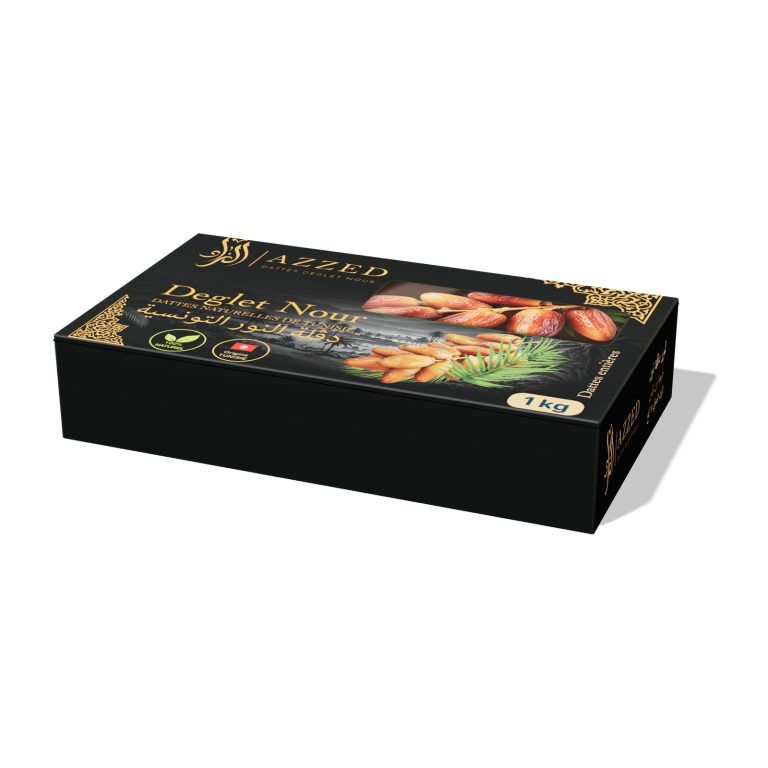
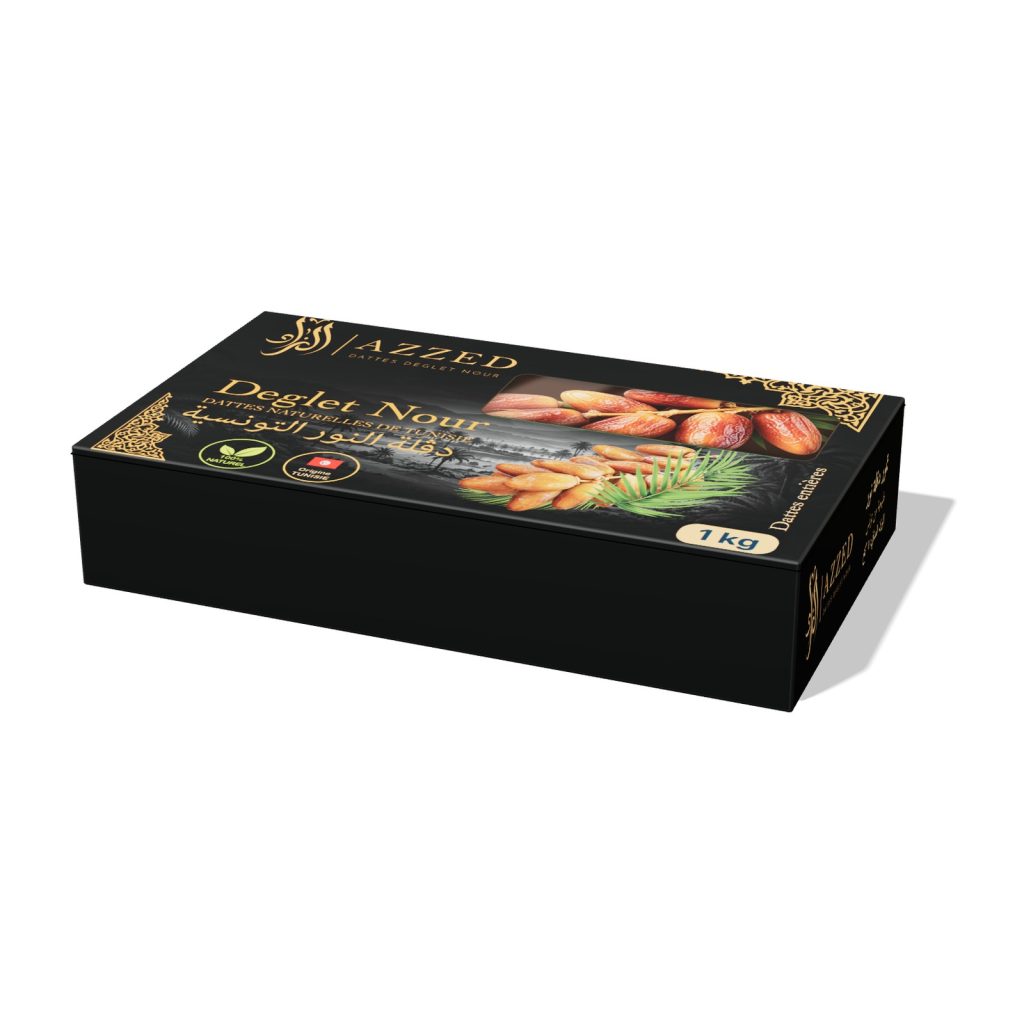
The dates are packed in consumer boxes in Tunisia and arrive ready for the shelf, sometimes with labels already applied, sometimes with an importer sticker added on arrival.
Usually suited to:
- smaller importers and retailers without packing facilities;
- first orders where you want to test a market without investing in local packing;
- shops that want a clear, finished product from day one.
Points to watch:
- printed materials must be agreed before packing, which lengthens the lead time;
- any mention that depends on your market must be validated by you in advance;
- the shipment takes more volume for the same net weight.
Option 3: a mix of both
Many small importers combine the two: a few retail boxes for immediate sale and bulk cartons for loose display or later repacking. Our article Building a Mixed First Order explains how to balance product forms in a first shipment.
Comparison table
| Question | Bulk cartons, repacked at destination | Retail-ready from origin |
|---|---|---|
| Who fills the consumer pack? | You or your local packer | The supplier, before shipment |
| Who usually finalises the label? | You, at destination | You validate it, the supplier applies it or you add a sticker |
| Lead time before shipment | Generally shorter | Generally longer (printed materials, approvals) |
| Volume per kilogram in transport | Lower | Higher |
| Flexibility on pack size | High | Fixed once printed |
| Extra steps at destination | Repacking, lot coding, labelling | Checking, sometimes a sticker |
| Good fit for a first test order | If you have a packer | If you have no packing facility |
| Main risk | Handling and traceability at repacking | Printing errors found too late |
Neither option is “better”. The right choice depends on your equipment, your volume, your channel and how quickly you need to be on the shelf.
What usually goes on a retail label for dates
The list below is general information, based on what consumer food labels commonly show in many markets. It is not legal advice and it does not replace your local rules. Requirements differ between countries and change over time: check with your food authority, your trade association or your customs broker, then send the supplier a written specification.
Product name
A clear description of what is in the pack, for example “Deglet Nour dates” or “Branch dates, Deglet Nour”. If the dates are pitted, the name should normally say so. Avoid creative names that hide the nature of the product; most markets expect the real name to be visible.
Variety
Deglet Nour is a recognised variety, and many shoppers look for it. Naming it helps customers who compare it with other varieties. If you want to explain the difference on the pack or on the shelf, our article Deglet Nour vs Medjool gives the main points.
Country of origin
Origin is often a mandatory mention for fruit, and it is also a selling point. “Product of Tunisia” is the usual form. Some brands add the region, for example the oases of Douz and Kébili in the Nefzaoua, as additional information. Any regional mention should be accurate and agreed with the supplier.
Net weight
The net quantity of dates, without packaging, in the unit used in your market (grams or kilograms in most countries). The size and position of the figure are regulated in many places, so ask your local rules for the exact format.
Lot code
The lot code links a pack to a production batch. It is essential for traceability, complaints handling and any withdrawal. Agree with the supplier who creates the lot code and where it is printed. If you repack bulk dates, keep a written link between the supplier’s lot and your own.
Best-before date
Dates are a dried fruit with a long shelf life in good conditions, but the date you print must be realistic for your storage and distribution chain. Decide the shelf life together with the supplier, in light of the harvest date and the conditions in your warehouse. Our guide Storing Deglet Nour Dates in Your Warehouse covers temperature, humidity and rotation.
Storage advice
A short line such as “Store in a cool, dry place” or “Once opened, keep refrigerated in a closed container” is common. It protects the consumer experience and reduces complaints about dried-out or sticky fruit.
Details of the responsible business
Most markets require the name and address of the business responsible for the product in that market, often the importer or the brand owner. This is usually a mention you control, and it is often the reason importers add their own sticker after arrival.
Language
The label must generally be written in a language the consumer understands, and some countries require one or several specific languages. Multilingual markets need special attention because space on a 1 kg box is limited.
Other mentions to ask about
Depending on the market and the product form, you may also need to consider:
- an allergen statement or a “may contain” mention, depending on the packing environment;
- a nutrition declaration, which some markets require on pre-packed foods and others exempt for single-ingredient products;
- a warning about stones, for pitted dates, where small fragments may remain;
- barcodes for retail scanning, usually provided by the brand owner;
- recycling marks, where packaging rules require them.
For each of these, the right answer comes from your local rules, not from the supplier. A good supplier will tell you what it can print and where; it cannot decide on your market’s legal requirements.
Label checklist table
| Mention | Usually who provides the content | Question to settle early |
|---|---|---|
| Product name | Importer, with supplier input | Exact wording in each language |
| Variety | Supplier confirms | Name it on the front or the back? |
| Origin | Supplier confirms | Country only, or region too? |
| Net weight | Agreed together | Unit and minimum figure size |
| Lot code | Supplier at packing, or importer at repacking | Format and position on the pack |
| Best-before date | Agreed together | Shelf life you will print |
| Storage advice | Importer, with supplier input | Wording in each language |
| Responsible business | Importer | Printed at origin or sticker on arrival? |
| Language(s) | Importer | Which languages, which order |
| Barcode | Brand owner | Who registers and supplies it |
Private label: discussed case by case
Private label means the pack carries your brand rather than the supplier’s. It is attractive for retailers who want a consistent range under one name, and for importers who build their own brand over time.
At Azzed, private label is not a standard catalogue offer. We are a local Tunisian Deglet Nour brand, and our export activity is still developing. When an importer asks for private label, we study the request case by case and answer in the quote: what we can pack, in which formats, with which materials, and what is not realistic for us. Some requests fit; others are better served by our own branded boxes plus your importer sticker.
To make that study useful, send us:
- the pack format you have in mind (box size, net weight, type of pack);
- whether you will supply printed materials or expect us to source them;
- the expected volume per order and the frequency;
- the market and language(s) of the label;
- your target date on the shelf.
A first order under your own brand is a bigger commitment for both sides than a trial order of branded boxes. Many buyers start with the supplier’s packs, check how customers react, and only then move to private label. Our article Selling Tunisian Deglet Nour in a Specialty Grocery explains how to test the product on the shelf first.
Artwork and lead-time questions to raise early
Most delays in retail packaging have nothing to do with the dates. They come from files, approvals and printed materials. Ask these questions in your first message, not after the price is agreed.
On artwork
- Who designs the artwork, and who owns the files?
- In which format are files expected (print-ready PDF, vector files, colour references)?
- Who checks the legal mentions before printing? (Usually the importer.)
- How many proof rounds are planned, and who signs the final approval?
- Where will variable data (lot code, best-before date) be printed, and by which method?
On materials
- Are boxes or labels printed in Tunisia, in your country, or elsewhere?
- If you supply materials, how and when do they reach the packing site?
- Is there a minimum print run for boxes or labels? This is often what makes very small private-label runs uneconomic.
- What happens to leftover printed materials if the design changes?
On timing
- How long between final approval and packed goods?
- Does the timing fit the harvest calendar? New-crop Deglet Nour is generally harvested from October to December. See The Tunisian Deglet Nour Year for Importers.
- Does the timing leave a margin before Ramadan or the year-end season? For Ramadan 2027, see Planning Your Ramadan 2027 Date Stock.
Timeline table
| Step | What happens | Typical risk |
|---|---|---|
| 1. Specification | You define pack, label mentions and languages | Missing mention discovered later |
| 2. Quote | Supplier confirms what is feasible and at what price | Private label request not yet studied |
| 3. Samples | You test the fruit and, if possible, the pack | Pack too fragile for your channel |
| 4. Artwork | Files prepared and proofs exchanged | Several rounds of corrections |
| 5. Final approval | You sign the proof | Approval given without checking legal mentions |
| 6. Materials | Boxes and labels printed and delivered | Print delays, minimum runs |
| 7. Packing | Dates packed, lot and date applied | Packing slot during harvest peak |
| 8. Shipment | Goods leave with the agreed documents | See our shipping guide |
The timing of each step depends on the project, so we give no fixed durations here. What matters is that every step exists and must be planned. For transport and documents, see Shipping Tunisian Dates Abroad.
Practical pack considerations for Deglet Nour
Protect the fruit, not only the brand
Deglet Nour has a soft-to-semi-dry texture and a natural sugar coating that can become sticky with heat and humidity. A good retail pack:
- closes properly after opening, or is easy to transfer to a container;
- resists the pressure of stacking in outer cartons;
- lets the customer see the fruit, if the presentation is part of the appeal;
- is filled to a weight that suits your customers’ consumption rhythm.
Branch dates and Arjoun
Branch dates keep the fruit attached to the strand, which makes them attractive for display and gifting but more delicate to pack. Deglet Nour Arjoun, the whole bunch, can weigh up to about 20 kg and is usually sold for events or striking displays rather than as a standard consumer pack. If you plan to sell either form at retail, discuss the presentation in detail with the supplier.
Standard dates and pitted dates
Standard dates are the most common choice for boxes and repacking. Pitted dates are available from Azzed on request; they are a different product to pack and label, so mention them clearly in your request.
Outer cartons and pallets
The consumer pack sits in an outer carton, which sits on a pallet. Agree on the number of units per carton, the carton marking (product, lot, net weight, number of units) and whether goods must be palletised for your warehouse.
Common mistakes with retail packs
Starting the artwork before checking local rules
A beautiful box that misses a mandatory mention must be reprinted or stickered. Check the rules first, then design.
Assuming the supplier knows your market’s requirements
The supplier knows its fruit and its packing line. You know your market. Write down what your label must contain.
Ordering private label for a first test
A first order is a test of the fruit, the supplier and your customers. Branded supplier packs plus your sticker are often a lighter way to start.
Printing a best-before date without a storage plan
The date on the pack is only reliable if the storage chain respects it. Align the date with your warehouse and shop conditions.
Changing the design after approval
Late changes reset proofs, materials and sometimes the packing slot. Freeze the artwork once approved.
Frequently Asked Questions
Is the supplier or the importer responsible for the label?
In most markets, the business that places the product on the market, often the importer or the brand owner, is responsible for label compliance. The supplier packs to your written specification. Check the exact rules in your country.
Can Azzed pack dates under my brand?
Private label is studied case by case. Send us your format, volume, market and timing through our contact form, and we will tell you in the quote what is realistic for us.
Can I add my own sticker after the goods arrive?
Yes, many importers do this to add their company details or a translation. Check with your local rules that a sticker is acceptable for the mentions concerned, and plan the labour at destination.
Which pack size should I choose for a first order?
It depends on your channel. Retail boxes such as 1 kg suit shops; bulk cartons suit repacking and loose display. Many buyers combine both in a mixed first order.
What lot code and best-before date will the packs carry?
They are agreed in the specification. The lot code links the pack to the batch; the best-before date should reflect the harvest date and your storage chain.
Should I ask for samples of the packaging as well as the fruit?
If the pack matters to your project, yes. Our guide Evaluating Deglet Nour Samples Before a First Order explains how to judge samples carefully.
Conclusion
A retail pack of Tunisian Deglet Nour is the meeting point of three things: good fruit, a label that fits your market, and a schedule that leaves time for files, materials and approvals. Decide early whether you buy bulk or retail-ready, write down what your label must contain after checking your local rules, treat private label as a project to study together, and raise artwork and lead-time questions in your very first message.
Azzed is a Tunisian Deglet Nour brand from the oases of Douz and Kébili. We are still building our export activity, and we study every request from small and mid-sized buyers for all our products. If you are planning retail packs, request a quote, read our Export and Quality pages, or message us on WhatsApp at +216 52 146 101.
Read next: What Moves the Price of an Export Quote for Tunisian Deglet Nour